
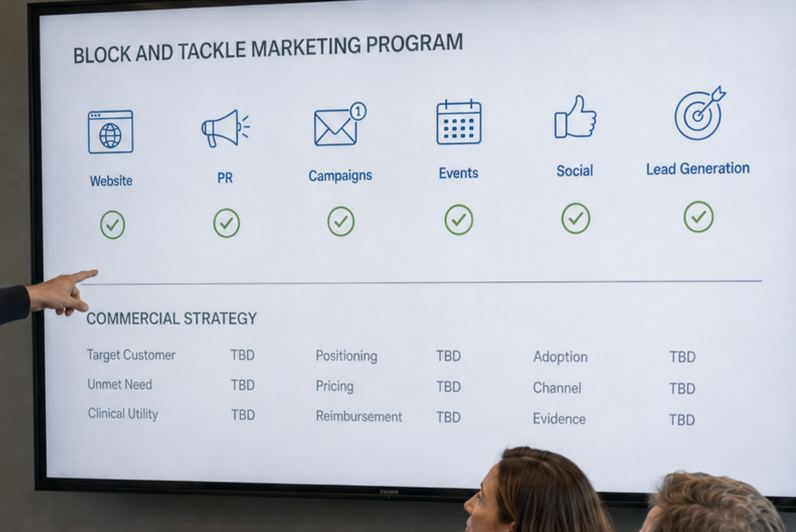
There is a slide that shows up, in one form or another, in a lot of life science companies. Across the top, a marketing program with every box checked green: website, PR, campaigns, events, social, lead generation. All live, all running, all staffed. Below it, the commercial strategy: target customer, unmet need, positioning, pricing, channel, clinical utility, reimbursement, evidence. Every line reads TBD. The team is busy. The team is also pointed at nothing.
This is not a marketing problem. It is a sequencing problem, and it is the single most repeated failure mode we see.
You Are Building the House From the Roof Down
Picture someone who buys a plot of land and hires a builder. Before the foundation is poured, they insist on installing the windows, hanging the front door, and finishing the facade. It looks like a house. Drive past and you would swear it was nearly done. Then it settles, cracks, and comes down, and they blame the builder. But the builder did not fail. The owner insisted on building everything you can see before building the one thing you cannot: the foundation that holds all of it up.
That is exactly what a fully staffed marketing program on top of a TBD commercial strategy is. The website, the campaigns, the events: those are the windows and the facade. They are the visible parts, they go up fast, and they make it look like progress is happening. The commercial strategy, who you are for, why they need you, how you get paid, is the foundation. It is invisible, it is slow, and it is the only thing that decides whether any of the rest stands up. Skip it, and the collapse is not a marketing failure. It was baked in the day you started building from the roof down.
Why Everyone Builds This Way
Tactics are seductive because they are legible. A campaign has an open rate. An event has a headcount. A website launch has a date. You can put each one on a slide with a green check and feel, correctly, that something happened. Strategy offers none of that comfort. "Who is our real buyer" does not have a completion date. "What is our defensible positioning" does not produce a dashboard. It is ambiguous, it is contested, and it makes people uncomfortable, so teams quietly route around it and get busy with the parts they know how to finish.
The result is motion mistaken for progress. Marketers are trained and rewarded to execute, and they will execute beautifully, even when no one has told them what the product is for or who it is for. Ask a demand-generation team to produce leads and they will. Whether those are the right accounts, whether the message lands, whether the economics work, that was someone else's TBD.
Tactics Answer "How." They Cannot Answer Who, Why, or Whether You Get Paid.
Every item in that top row is an answer to a "how" question. How do we reach people? How do we generate awareness? How do we capture interest? Good questions, but downstream ones. They only pay off once you have answered the questions underneath. Who exactly is this for, and is that a real, reachable segment? What unmet need are we solving, and do buyers agree it is unmet? Why us, over the alternative they already use? What is the price, and will the economics survive first contact with a payer? What evidence does a clinician or a lab need before they change what they do?
Run the tactics before you have those answers and you are amplifying a message you have not written to an audience you have not chosen. The louder you get, the faster you spend, and the more convincingly you prove that you do not yet know what you are selling or to whom.
The TBDs That Quietly Break the Program
Look again at what was left blank, because none of it is optional. Target customer left TBD means every campaign targets everyone, which is the same as no one. Positioning TBD means the website lists features, because no one decided what the product stands for. Pricing TBD means the sales team improvises and the market anchors low. Clinical utility and reimbursement TBD mean, as any diagnostics team eventually learns the hard way, that adoption is capped no matter how good the funnel is. Evidence TBD means the buyer nods politely and does nothing. Each blank is a crack in the foundation. You will not see them while the facade goes up. You will see them all at once, later, when the thing you built stops standing.
How to Tell Which One You Are
You can usually diagnose it in a sentence. If your team can name the ideal customer, the one unmet need, the positioning against the real alternative, and the path to getting paid, without a debate breaking out, you have a strategy, and the tactics are worth running. If those answers come back as slogans, ranges, or "it depends," you do not have a strategy yet. You have a marketing program keeping busy while the important questions stay open, and no amount of execution will close them for you.
Foundation First, Then the Same Tactics Actually Work
None of this makes the block and tackle worthless. Website, PR, campaigns, events, social, and lead generation are exactly what you need, once they have something to carry. The same demand-generation engine that burns money against an undefined audience becomes efficient the moment it is aimed at a real customer with a real message. The sequence is the whole game: define who you are for, why they need you, and how you get paid, and then let the tactics do what they are good at. Pour the foundation, and the windows and the facade go up on something that will hold.
That is the entire reason our platforms exist. PRIYA is built to turn those TBD lines into answers, systematically, before the money goes out the door, and MAYA to make sure your team is actually aligned behind them, so the marketing program you are so busy running is finally pointed at something real.
The Bottom Line
Busy is not the same as effective, and a checklist of finished tactics is not a commercial strategy. The green checks feel like progress and change nothing while the strategy underneath them reads TBD. If the house is going to stand, you pour the foundation first. And every time someone insists on the facade instead and the thing comes down, they go looking for a builder to blame. The builder was never the problem. The order was.
How many of your commercial lines are still TBD? See what PRIYA surfaces.
Back to Blog