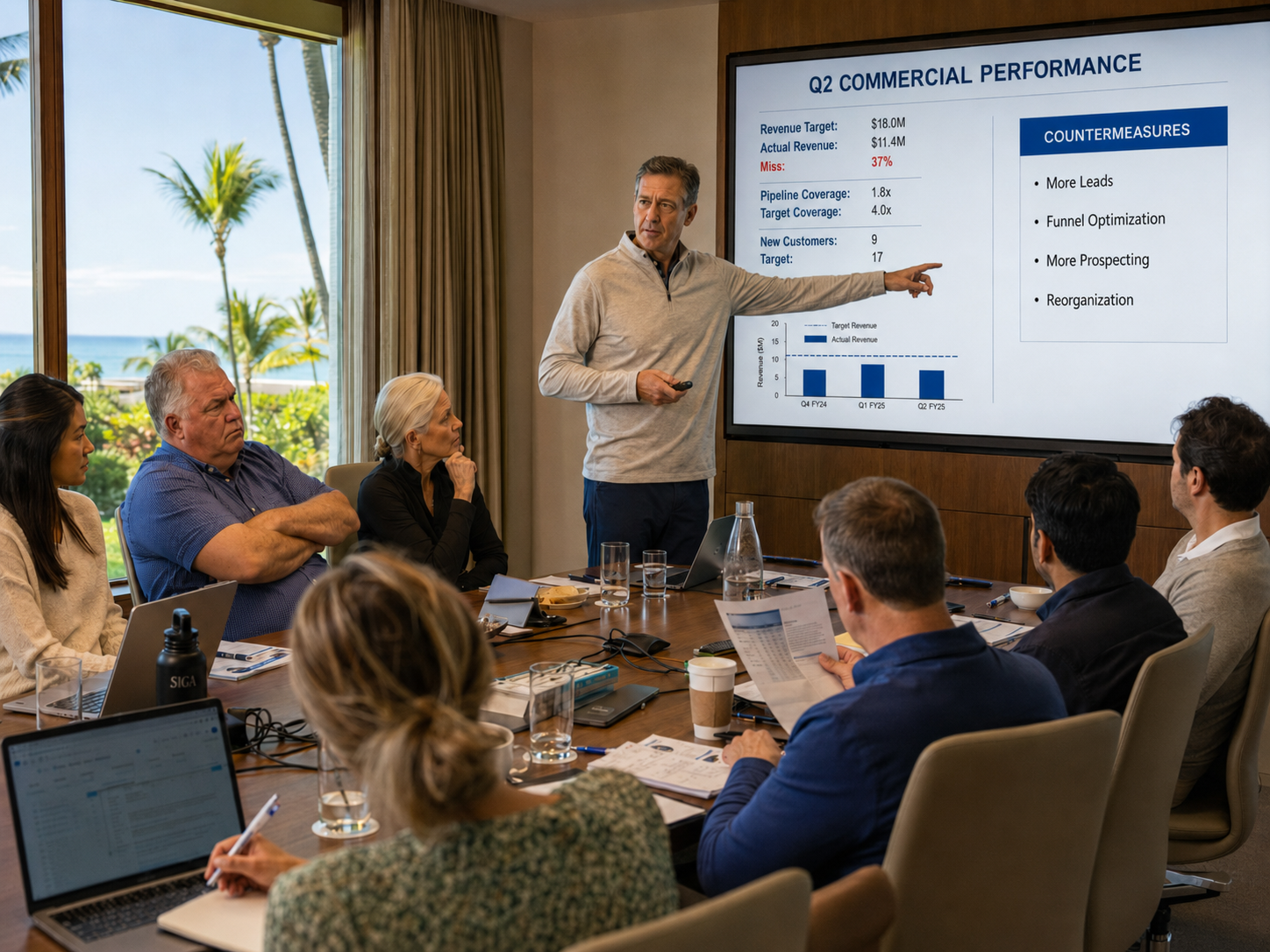
Artificial intelligence has changed how we work. It summarizes complex documents in seconds. It drafts emails, builds financial models, and can parse a 200-page FDA submission before your coffee gets cold. For life science founders and CEOs under pressure to move fast, the temptation is obvious: upload your pitch deck, your market research, and your competitive landscape into your favorite AI tool and ask it to spit out a go-to-market plan.
We've seen people try. The output looks impressive at first glance. Clean formatting. Confident language. Strategic-sounding recommendations.
And that's exactly the problem.
The Illusion of Completeness
Large language models are extraordinary pattern matchers. They've ingested billions of words across every domain. But pattern matching is not the same as domain judgment, and when it comes to commercializing a life science product, the difference is the gap between a slide deck and a successful launch.
Here's what happens when you ask a general-purpose AI to build your GTM strategy:
Variability. Run the same prompt twice and you'll get two different answers. Change a few words in your input and the output shifts again. Strategic decisions that will determine whether your company raises its next round or stalls out should not depend on how you happened to phrase the question on a Tuesday afternoon.
No domain memory. LLMs don't carry forward institutional knowledge about what actually works in diagnostics reimbursement, or how IVD regulatory pathways shape your commercial timeline, or why your pricing strategy needs to account for lab economics that most consultants have never seen from the inside. They approximate. In life sciences, approximation is expensive.
No accountability structure. An AI doesn't know what it doesn't know, and it will never tell you it's uncertain. It will confidently recommend a pricing strategy that ignores payer dynamics, or a channel strategy that conflicts with your regulatory classification. There's no feedback loop. No one is accountable for the recommendation.
Surface-level analysis. Ask an LLM to evaluate your go-to-market readiness and it will assess what you gave it. It won't ask about what's missing. It won't probe the assumptions behind your TAM. It won't flag that your ICP definition contradicts your reimbursement strategy. It treats each input as independent when, in reality, everything is connected.
The House of Cards
This is the part most founders don't see until it's too late.
A life science go-to-market program is not a collection of independent workstreams. It's a load-bearing structure where every element depends on the integrity of the others. Think of it as a suspension bridge: regulatory strategy anchors one side, market access anchors the other, and spanning between them are the cables of pricing, positioning, channel strategy, sales execution, clinical evidence, and reimbursement. Cut one cable and the deck doesn't just sag. The load redistributes, stress concentrates at the weakest remaining points, and the whole structure can fail in ways that aren't obvious until you're standing on it.
Your regulatory classification shapes your reimbursement pathway. Your reimbursement pathway constrains your pricing. Your pricing dictates your channel economics. Your channel economics determine whether your sales model is viable. Your sales model defines your revenue forecast. Your revenue forecast is what investors use to decide whether to write the check.
Every layer depends on the one before it. An AI that evaluates them independently will miss the cascading failures that bring companies down.
The Founder's Dilemma
Here's the uncomfortable truth most people won't say out loud: if you're a founder or CEO without deep commercial experience in life sciences, you may not know where your blind spots are. That's not a criticism. It's the nature of blind spots.
You might have world-class science. A strong IP position. A clinical story that genuinely excites KOLs. But the gap between clinical validation and commercial success is where most life science companies stumble, and it's a gap that requires a specific kind of expertise to even see, let alone close.
Traditional consulting can help, but it's slow, expensive, and what you get is often one person's subjective opinion dressed up in a slide deck. You're paying for experience, but you're also inheriting that consultant's biases, blind spots, and the limits of whatever they happened to work on in their last role.
Until now, there hasn't been a way to get a fast, objective, comprehensive read on where your commercial program actually stands, one that doesn't depend on who you hire or how they happened to frame the problem.
A Different Approach: Platforms That Diagnose, Operators Who Fix
This is why we built MAYA, PRIYA, and GAIA.
MAYA starts where every GTM program should start: with your leadership team. Are you aligned on what matters most? MAYA scores your team's alignment across the 11 critical dimensions of go-to-market and surfaces where your priorities diverge. Because if your leadership team isn't aligned on the problem, no amount of execution will fix it. MAYA replaces gut-feel prioritization with a structured, repeatable assessment that shows you exactly where to focus first, based on revenue risk exposure.
PRIYA goes deeper. It's a comprehensive product-market fit and commercial readiness validation, powered by a 225-rule engine built from decades of hands-on life science commercialization. This isn't an AI guessing at what good looks like. It's a deterministic rules engine, augmented by AI, that evaluates your GTM program the same way every time, against the same rigorous standards, and tells you exactly where the gaps are. No variability. No subjectivity. Just evidence-based analysis you can trust and act on.
GAIA is the full picture. It evaluates your entire go-to-market program across 13 critical dimensions, encompasses everything PRIYA covers plus additional strategic layers, and delivers a prioritized roadmap so you can focus resources on the areas with the greatest commercial impact.
What would take even a seasoned commercial leader weeks to assess, our platforms deliver in a fraction of the time. And because they're deterministic, you get consistency. Run it today, run it next quarter after you've made changes, and measure real progress against the same yardstick.
Don't Take Our Word for It. We Validated It.
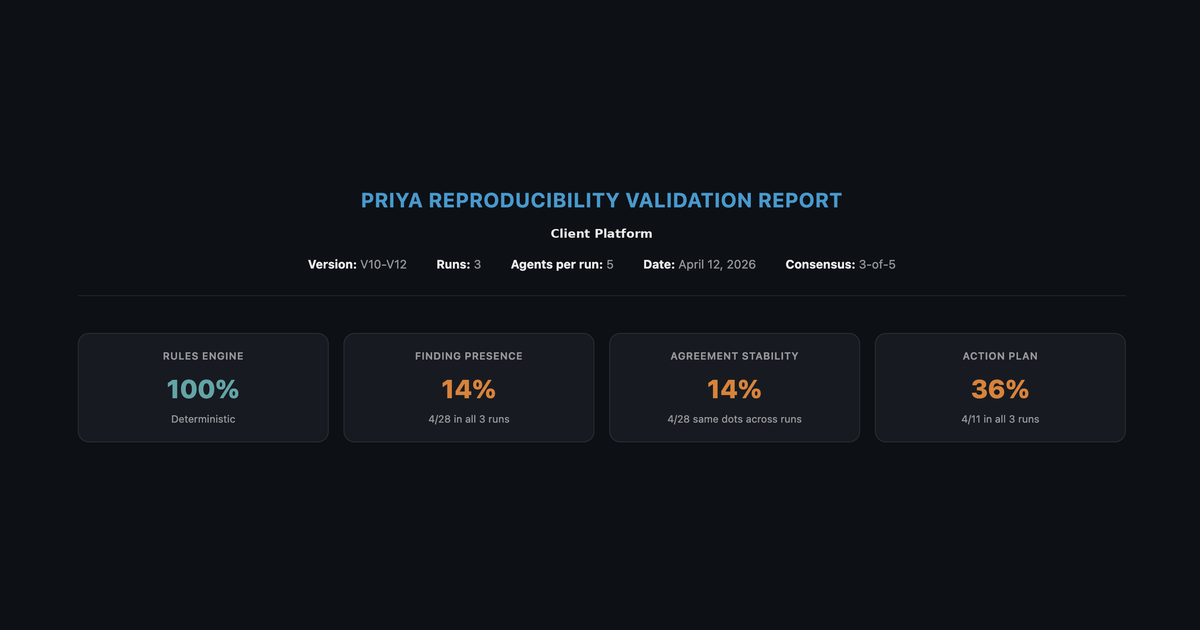
We knew that claiming consistency wasn't enough. We had to prove it. So we ran a formal reproducibility validation study on PRIYA.
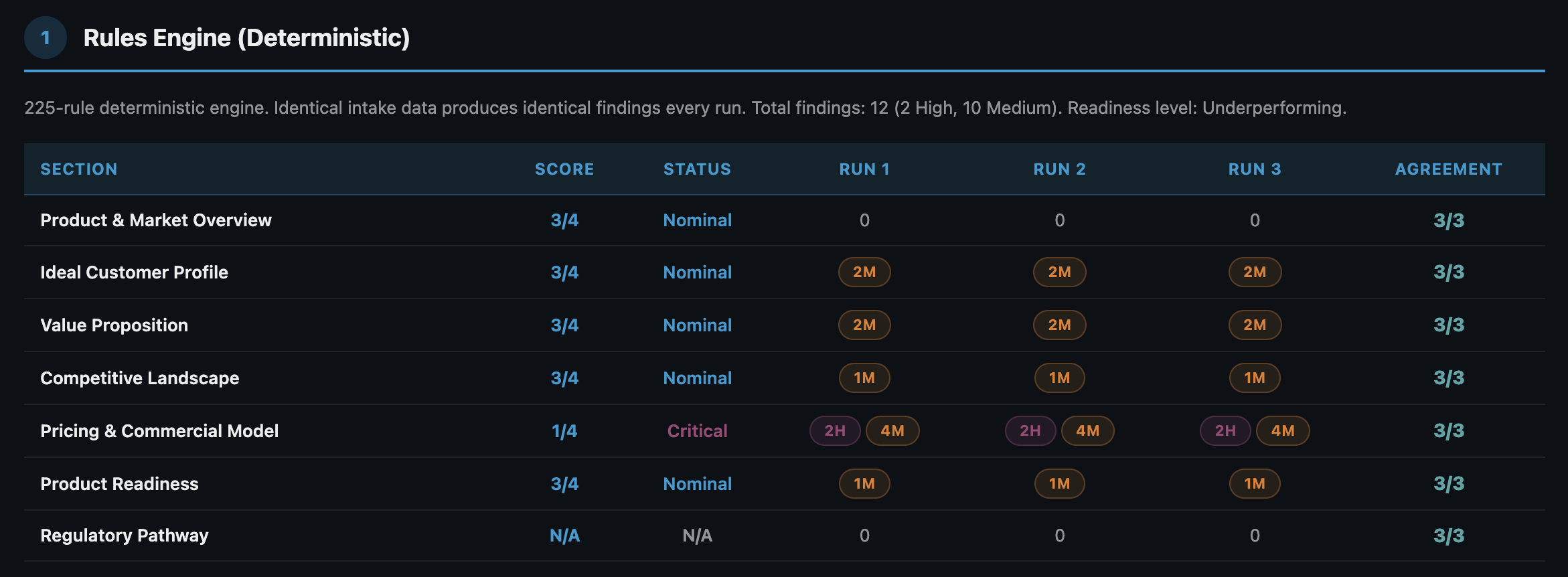
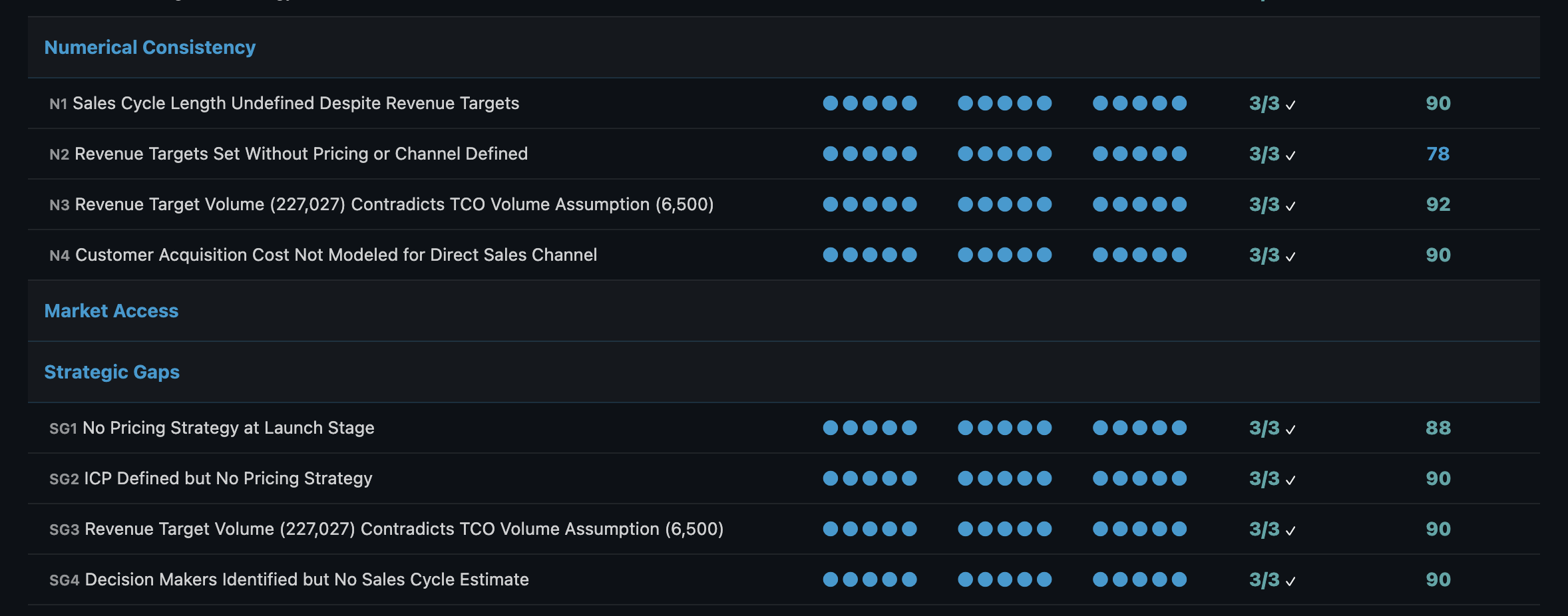
Here's what we did: we took a representative product submission (a launch-stage IVD diagnostic) and ran it through the full PRIYA pipeline three separate times, each time with five independent AI agents evaluating the submission alongside the deterministic rules engine. The agents didn't see each other's work. The runs were independent. If the system was producing variable, unreliable output the way a general-purpose LLM would, the results would diverge. They didn't.
The rules engine returned identical findings across all three runs. 100% agreement. That's the deterministic backbone doing exactly what it's designed to do.
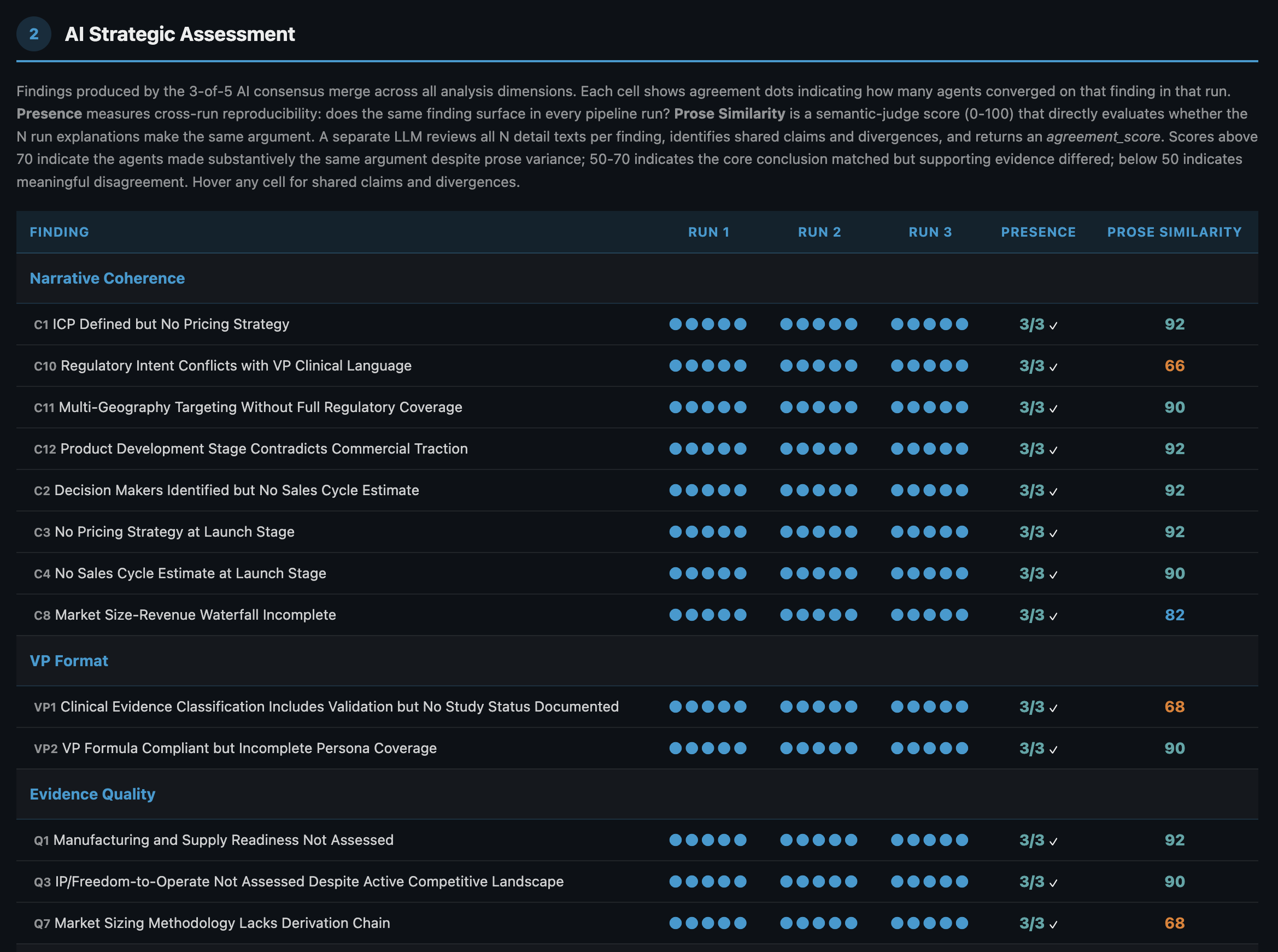
But the AI-augmented strategic layer, the part that goes beyond rules and provides nuanced commercial analysis, also held up. Of the 21 strategic findings surfaced, every single one appeared in all three runs. 100% presence. The prose similarity score, measured by an independent semantic judge evaluating whether the agents made the same argument, averaged 86%. Not identical phrasing, but substantively the same conclusions drawn from the same evidence.
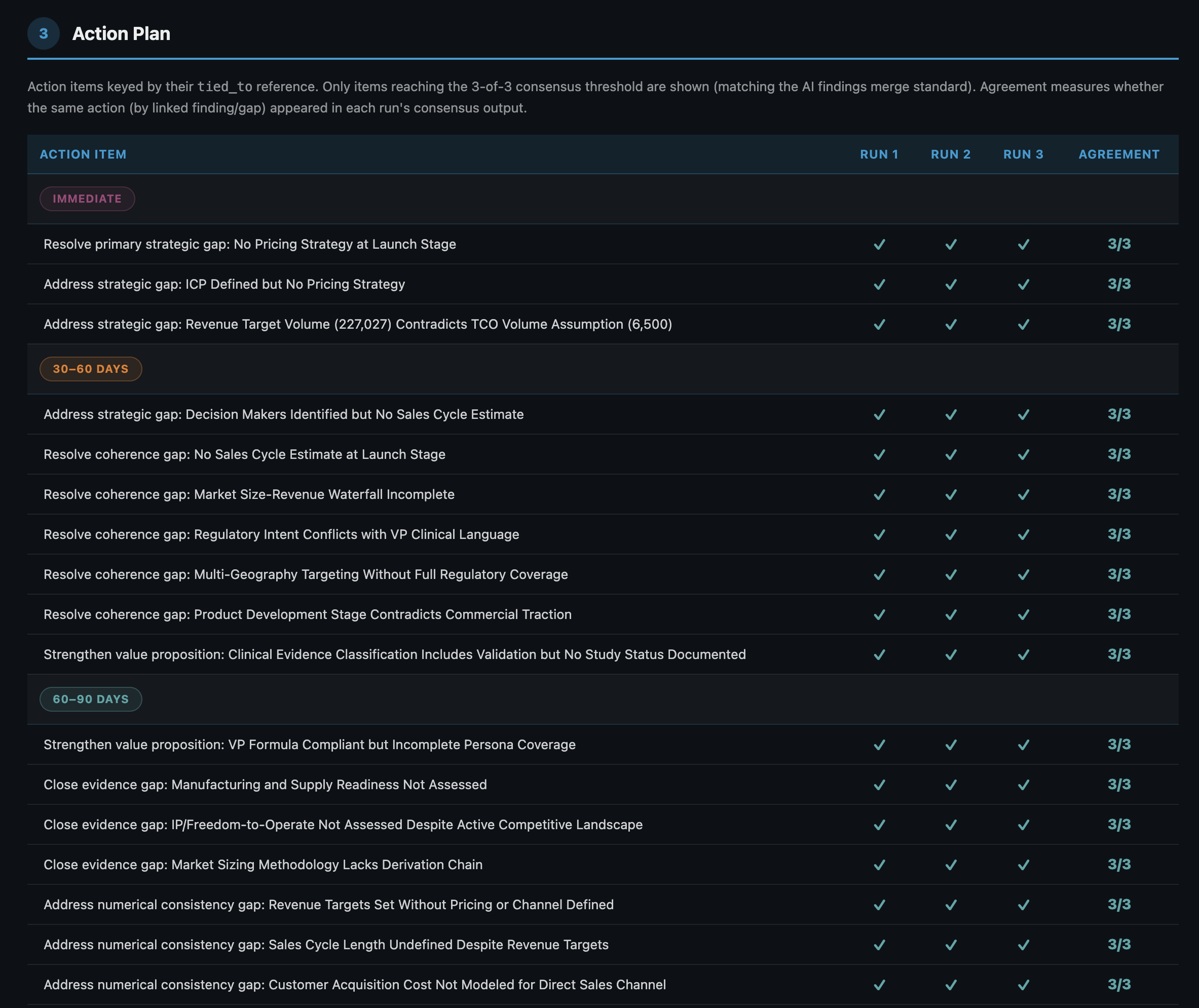
The action plan was equally stable: all 17 recommended actions appeared in every run, with the same prioritization and the same urgency classifications.

This is the difference between a system built for serious commercial decisions and a chatbot that gives you a different answer depending on the day. When investors ask how you validated your go-to-market readiness, you can point to a platform that was itself validated for reproducibility. That's a level of rigor most consultants can't offer, and no general-purpose AI even attempts.
Why This Matters for Fundraising
If you're preparing for a raise, here's what your investors are evaluating whether you realize it or not: the probability that your product will succeed commercially.
They're not just looking at your science. They're assessing whether you have a realistic path to revenue. That means they're evaluating your regulatory strategy, your market access plan, your ICP definition, your value propositions, whether your forecasts are grounded in reality, whether your pricing fits the market, and whether your team has the commercial muscle to execute.
Every gap in your go-to-market program reduces your probability of success. Every reduction in probability of success compresses your valuation. Investors who do serious diligence will find the gaps. The question is whether you find them first.
MAYA, PRIYA, and GAIA were built to answer that question. They give founders and CEOs a structured, evidence-based view of their commercial readiness before they walk into the room. So when an investor asks, "How do you know your go-to-market is ready?" you don't have to rely on confidence and a slide deck.
You can show them the data.
The Bottom Line
AI is a powerful tool. We use it every day. But a powerful tool without a framework, without domain expertise, and without accountability is just a faster way to get the wrong answer.
What life science companies need isn't more AI-generated opinions. It's a system that combines the rigor of deep domain expertise with the speed and consistency of purpose-built technology. One that pinpoints mission-critical go-to-market gaps so seasoned operators can fix them, and founders can raise with confidence and scale with clarity.
That's what we built. And that's what we do.
Curious what a reproducible GTM assessment actually looks like?
Back to Blog