
When that number misses, you are the one who answers for it. Not the board that accepted it. Not the market that declined to cooperate. Not the marketing team you handed it to eighteen months later. You made the commitment, and you will be the one explaining the shortfall.
Which makes it worth being careful about where the number came from in the first place.
Here is the pattern. A growth figure gets chosen before anyone checks whether it can exist. It comes from a multiple of last year, or an investor's expectation, or a valuation the company needs to justify, or a competitor's press release. It goes into a board deck and becomes a commitment. Then, some months later, it lands on the commercial team with an implicit instruction attached: go make this true.
They cannot. Not because they are not good, but because by the time the number reaches them the question has already been settled. The market either contains that revenue or it does not, and no volume of campaigns changes the arithmetic. Activity is not a substitute for a market.
Start With What the Market Can Actually Hold
Start here and you will almost certainly start too big. Category reports are written to be impressive. They size a whole category rather than the specific segment your product can serve, and they usually count every dollar that changes hands rather than the portion that reaches you.
That second distinction quietly ruins more forecasts than any other. If you sell a kit to a lab, the market report counts what the lab collects from the payer. You collect what the lab pays for the kit, which is a fraction of it. If you sell an instrument, the report may be counting the tests it runs. If you sell software into a service provider, the report is counting the service, not your license. In every case the dollars are real and most of them belong to somebody else.
Correct for both, the segment you can genuinely serve and the share of each dollar that reaches your own P&L, and a market that looked like hundreds of millions often resolves to tens. That is not a disappointing finding. That is the first honest input you have had.
Growth Is Not a Rate You Choose
Once the size is right, the next temptation is to let growth carry the plan. Ask what the segment itself is growing at. If the answer is eight percent and you have committed to triple digits, then almost none of your number comes from the market expanding. It comes from taking share.
That is a different plan with a different cost and a different timeline, and it deserves to be named rather than buried inside a curve. Share is bought with evidence, with people, and with time.
Adoption has its own physics too. Sales cycles in life sciences run months and often longer. Evaluations need samples, protocols, validation runs, and committee approvals that meet on their own schedule. A quarter is a unit of reporting. It is not a unit of adoption.
Your Competitors Get a Vote
Share does not come from an empty room. It comes from an incumbent who already has the relationship, the contract, the validated workflow, and every incentive to keep all three.
So the question is not whether you are better. It is what it costs a customer to switch, who inside their organization has to sign off, how long their current agreement runs, and what the incumbent does when they notice you. A forecast that assumes the competition holds still is not a forecast.
Have You Earned the Right to Play
Before anyone weighs whether you are better, you have to clear the bar to be considered at all. In life sciences that bar is specific and unforgiving. Regulatory status. Reimbursement, or a credible path to it. Guideline inclusion where guidelines drive behavior. A lab or a channel that can actually deliver. Reference accounts somebody will call. Support that survives a bad week.
Miss one of those and you are not competing in that market. You are adjacent to it, having conversations that cannot convert. A surprising number of forecasts book revenue from segments the company has not yet earned the right to sell into.
Why You Win, and What Happens If You Do Not
The claim that actually wins deals is narrower than the claim most companies make. It has to survive contact with a customer who has heard every version of it, a procurement officer who wants a side-by-side, and a competitor who gets to answer it in the next meeting.
Then take the harder step and write down what has to be true for the number to hold. A study reads out on time. A code gets issued. A partner signs. Two reps get hired and become productive. Each of those is an assumption with a probability attached, and an honest forecast attaches one. Do that and you usually discover the number was never a single number. It is a range, and the top of it depends on several things going right at once.
That is not pessimism. It is the difference between a commitment you can manage and a commitment that manages you.
The Only Number Worth Promising
There are three numbers on every market slide, and only one of them belongs in a commitment.
TAM, the total addressable market, is the whole category. Everyone who could conceivably buy something like what you sell, if geography, regulation, channel access and competition all vanished. It is a context number. It tells a board the space is worth being in. It was never designed to be a target, and it does not become one just because it sits on the same slide as your forecast.
SAM, the serviceable addressable market, is the portion of that category you could realistically serve once you put reality back in. The geographies you are cleared to sell into. The regulatory status you actually hold today, not the one you have filed for. The channel you actually have. The segments where your product genuinely fits rather than technically applies. SAM is narrower and more honest than TAM. It is still not a forecast.
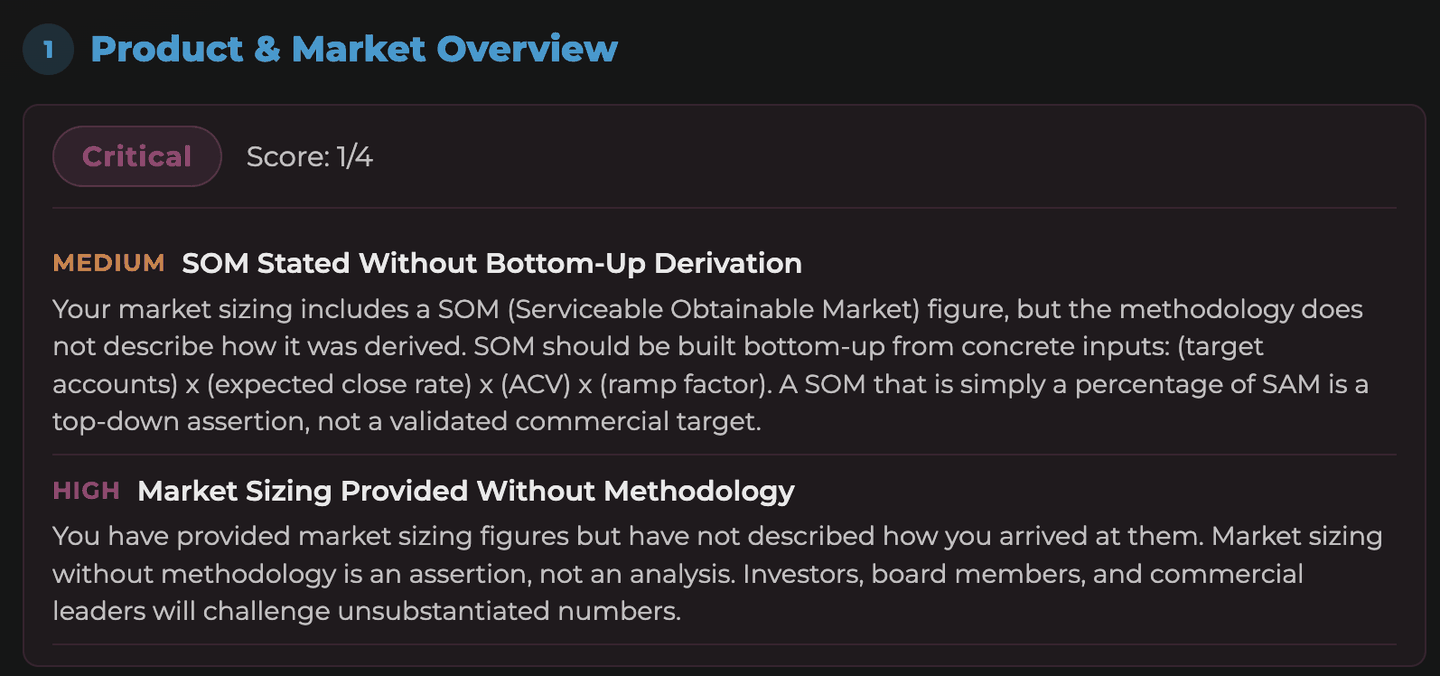
SOM, the serviceable obtainable market, is the number you have to defend, and it is the only fair one to promise. It is what your commercial organization, as it exists today, can actually win in the time you actually have. Not the market you could theoretically address. The revenue your team can close. When a board asks what you will deliver, SOM is the honest answer. TAM is the answer that comes back for you a year later.
It gets built from the bottom, out of things you can count. How many accounts genuinely match your customer profile. How many of those your team can reach given its current size. How many convert, at what rate, based on the evidence you have today rather than the evidence you hope to have. What an average deal is worth. How long one takes to close. How long a new hire takes to become productive. Multiply through, subtract the ramp, and you have a number with a trail behind it.
The tell is simple. If someone asks how you arrived at your SOM and the answer is a percentage of your SAM, you did not build a forecast. You picked one. Every number you can actually defend traces back to accounts, people, and time.
The Coupling Is the Whole Point
Build the number this way and something useful happens. It couples to the commercial engine, which means it becomes something you can steer instead of something you defend.
If close rate slips, you know exactly which line moves and by how much. If a hire slips a quarter, you know what it costs. If the evidence package lands early, you know what it unlocks and when. The forecast stops being a quarterly interrogation and becomes an instrument.
That coupling also buys you the one thing an invented number can never buy. When something changes, you can go back to the board with a revision that has reasoning attached. Boards will forgive a number that moves for a reason they can follow. They will not forgive a number that was never real.
The Bottom Line
Do yourself a favor. Before you commit to anything, find out what the market can hold, what the segment is growing at, who you have to take share from, whether you have earned the right to be considered, and why a customer picks you when the incumbent pushes back. Then build the number up from your own accounts, your own team, and your own calendar.
You will almost certainly land somewhere smaller than the figure you were going to promise. You will also be able to defend every dollar of it, and you will hit it.
The alternative is to promise first and go looking for the market afterward. That is not a strategy. It is a request for someone else to find revenue that was never there, and it ends the same way every time.
Find out whether your number survives a 225-rule check, before your board asks.
Back to Blog