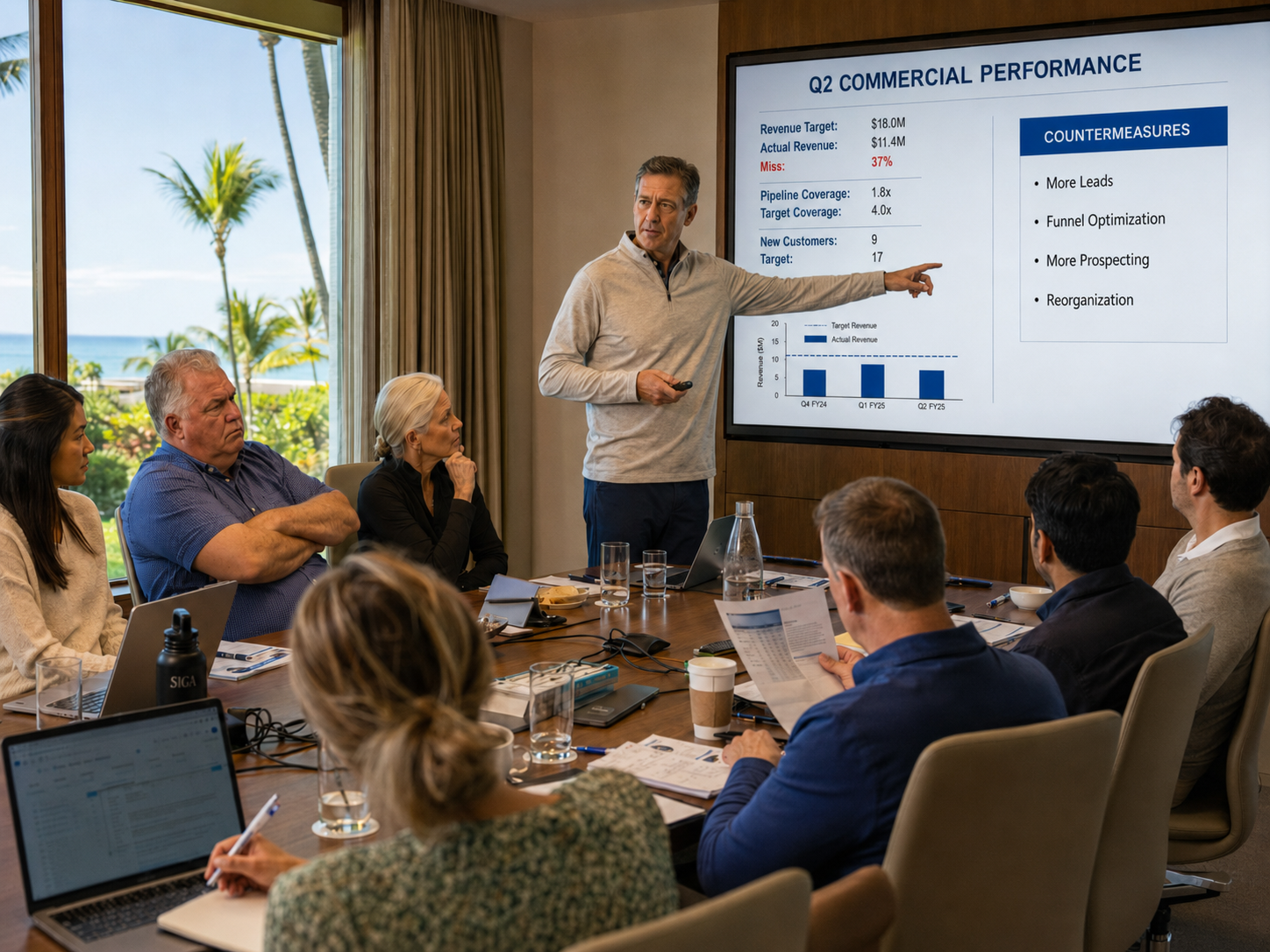
Life sciences is one of the most complex investment landscapes in the world. Every deal sits at the intersection of science, regulation, reimbursement, clinical evidence, and commercial execution. The interdependencies are real: a regulatory classification shapes the reimbursement pathway, which constrains pricing, which dictates channel economics, which determines whether the sales model is viable, which drives the revenue forecast investors use to write the check.
Most investors understand the science. Many can evaluate the regulatory pathway. But the commercial layer, the go-to-market program that turns a cleared product into revenue, is where the blind spots live. And in life sciences, a blind spot in due diligence doesn't just reduce returns. It can eliminate them.
The Complexity Problem
Life science commercialization is not like launching a SaaS product or a consumer brand. The market has fewer buyers, longer sales cycles, and multiple decision-makers with different incentive structures. A hospital lab director, a procurement officer, a medical director, and a payer all have to say yes before you generate revenue. Miss any one of them in your commercial strategy and the whole model breaks.
For investors without decades of operating experience in this space, these dynamics are hard to evaluate. The pitch deck will show you a TAM, a SAM, a revenue forecast, and a set of growth assumptions. What it won't show you is whether the ICP definition actually maps to the reimbursement pathway, whether the pricing can survive payer pushback, whether the clinical evidence package is strong enough to drive adoption, or whether the sales model accounts for the 12-18 month procurement cycles that are standard in institutional diagnostics.
These aren't edge cases. These are the dynamics that determine whether a life science company hits its revenue targets or stalls after launch.
The Traditional Due Diligence Gap
Investors typically address commercial diligence in one of two ways. Some rely on their own team, asking smart questions during the pitch process and stress-testing the assumptions in the financial model. Others hire a consulting firm or industry expert to run a third-party commercial assessment.
Both approaches have real limitations.
Internal teams, no matter how experienced in general venture or growth investing, may not have the depth of life science commercial expertise needed to identify the specific gaps that derail launches in this space. They know what good looks like in general terms. They may not know what good looks like for an IVD company navigating CPT code strategy, or a therapeutic diagnostics company building a KOL network in a fragmented specialty market.
Third-party assessments take time, typically 6-12 weeks, and what you get is one expert's subjective opinion. Run the same assessment with a different expert and you'll get different conclusions. There's no standardized framework, no reproducible methodology, and no way to benchmark one portfolio company's commercial readiness against another using the same yardstick.
When you're deploying capital into a space where fewer resources, longer timelines, and complex market dynamics already compress the margin for error, the quality of your commercial due diligence isn't a nice-to-have. It's the difference between a portfolio company that scales and one that burns cash trying to figure out why revenue isn't materializing.
What Rigorous GTM Due Diligence Actually Looks Like
A comprehensive go-to-market assessment for life science investments needs to evaluate the full commercial architecture, not just the pieces the founding team chose to put in the pitch deck.
That means examining market definition and segmentation: is the total addressable market grounded in real purchasing behavior, or is it a top-down number pulled from a market report? Is the serviceable addressable market realistic given the company's regulatory classification, geographic reach, and competitive position? Is the obtainable market supported by a credible go-to-market motion?
It means evaluating pricing and reimbursement strategy in the context of the specific product category. Not "is the price reasonable" but "does the pricing model account for lab economics, payer mix, coverage pathways, and competitive alternatives?"
It means assessing the clinical evidence strategy, the KOL and reference account plan, the channel and distribution model, the sales organization design, the competitive positioning, and the operational readiness to actually execute a launch.
And critically, it means understanding how all these dimensions interact. Because in life sciences, a gap in one area cascades into every downstream element.
Built for Investors Who Need to Cut Through the Noise
This is why we built PRIYA.
PRIYA is a commercial readiness and product-market fit assessment powered by a 225-rule deterministic engine augmented by AI strategic analysis. It evaluates whether a life science product is actually ready for market, not just whether the team believes it is.
It was designed for exactly this use case: giving investors (and the companies they back) an objective, reproducible, evidence-based view of commercial readiness and product-market fit that identifies gaps, risks, and misalignment before they become expensive problems.
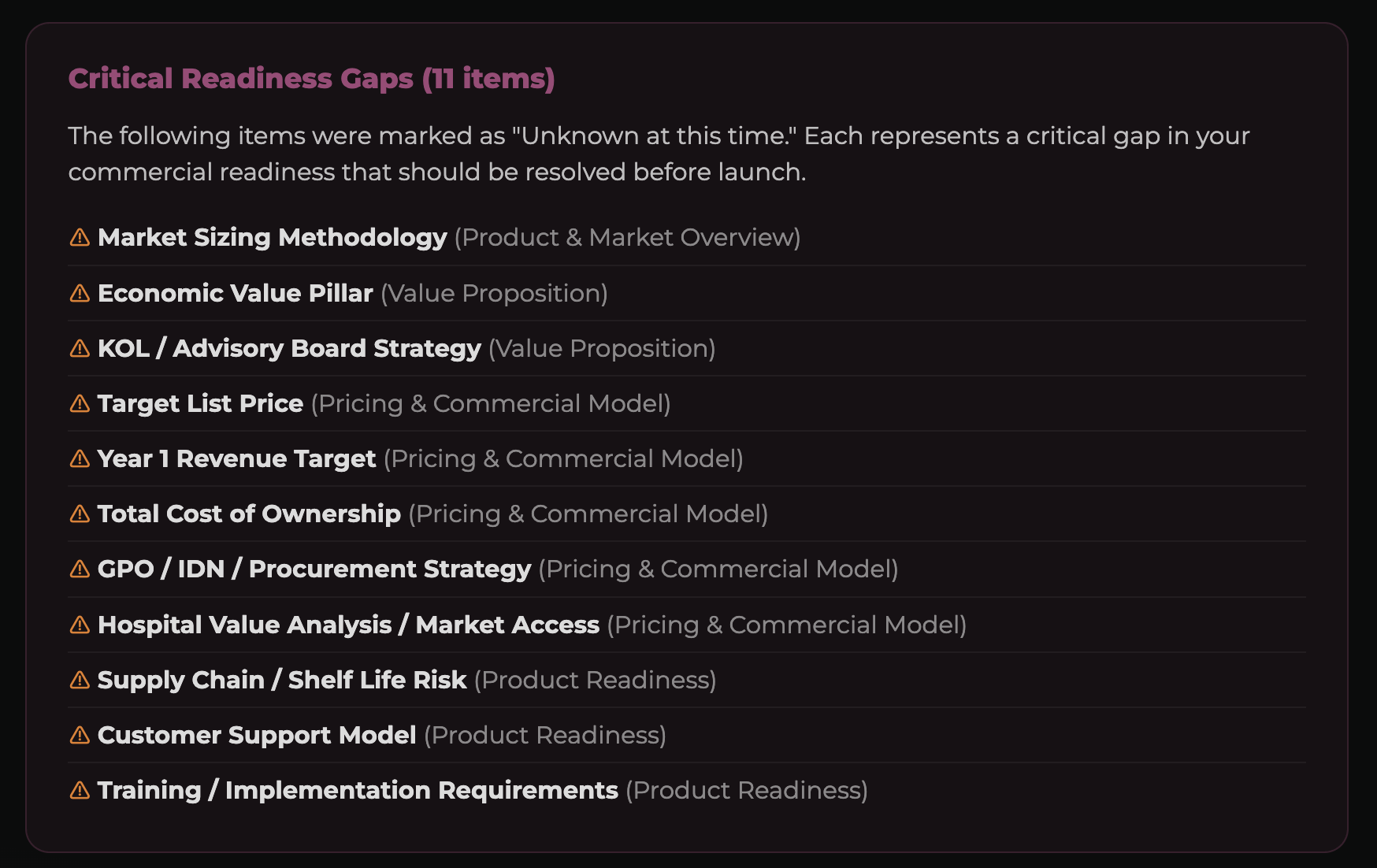
PRIYA surfaces critical readiness gaps that traditional due diligence overlooks.
What makes it different from traditional due diligence:
Objective and deterministic. The 225-rule engine evaluates every submission against the same rigorous standards. No subjectivity. No variation based on who runs it or when. The same gaps get flagged every time.
Comprehensive. PRIYA evaluates product-market fit, competitive positioning, value proposition, pricing strategy, reimbursement and market access, clinical evidence, channel strategy, sales model design, operational readiness, and commercial viability. It doesn't skip what's uncomfortable.
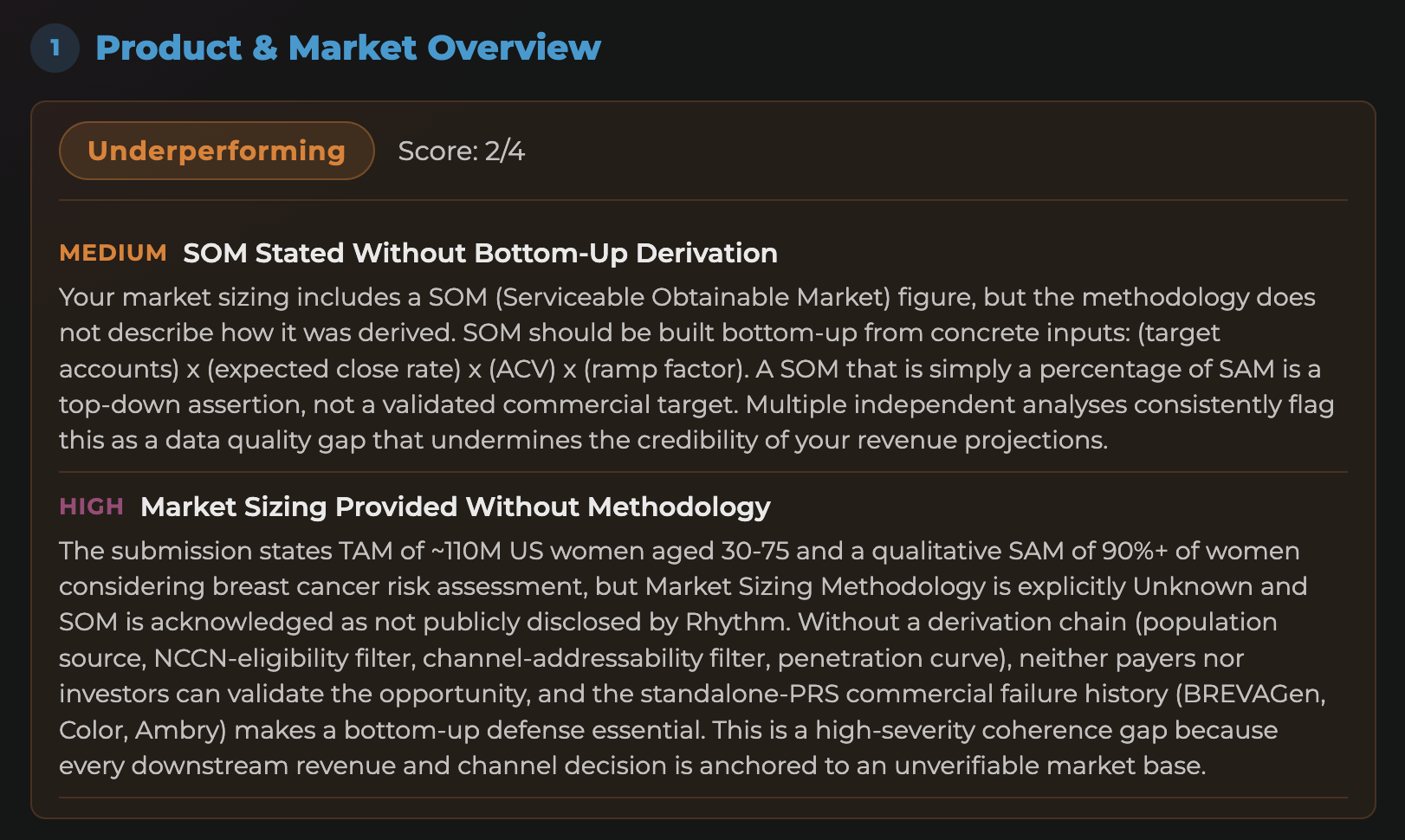
PRIYA's rules engine flags market sizing gaps that weaken investor confidence.
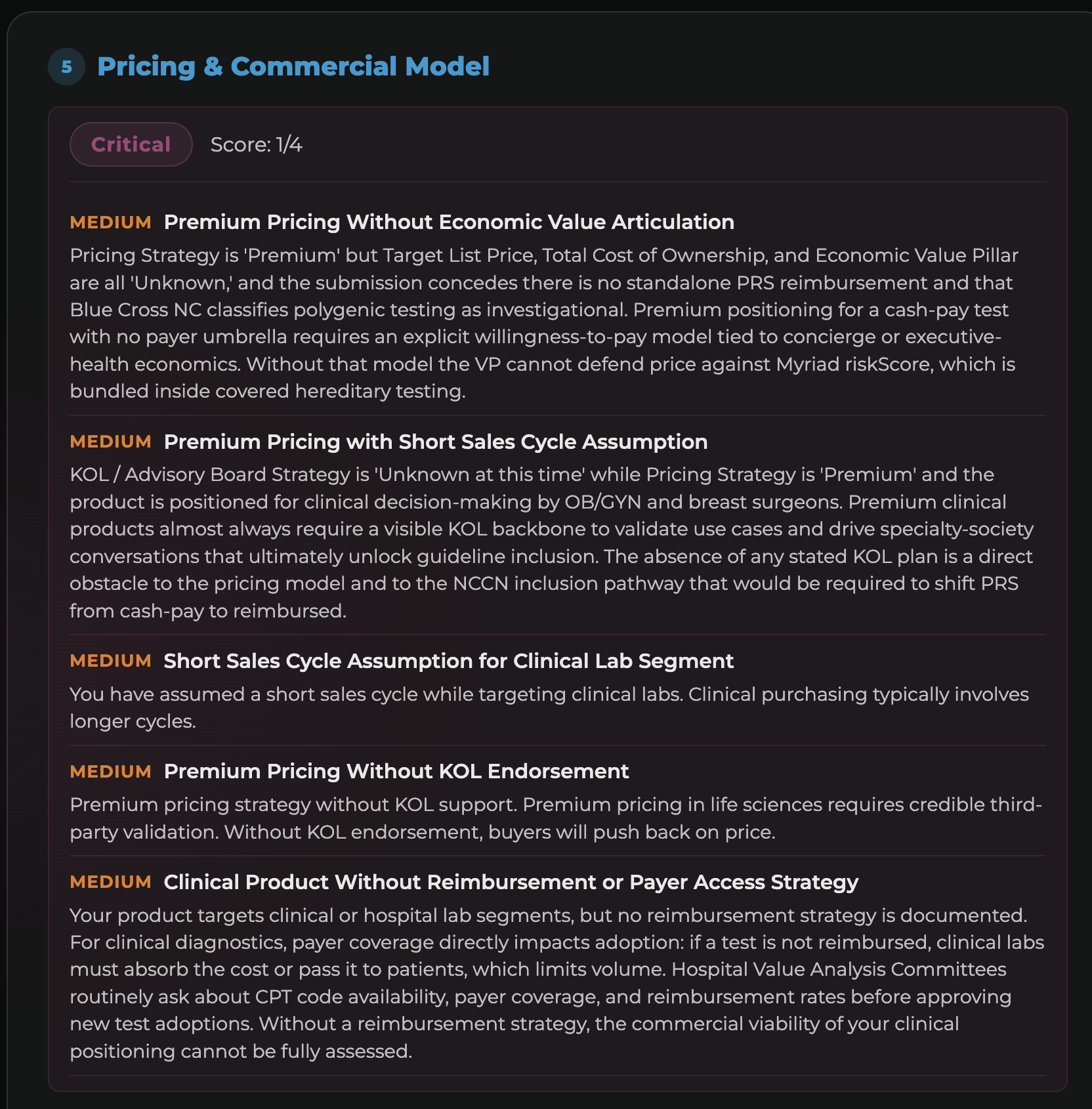
Pricing strategy gaps scored and explained with specific, actionable detail.
Fast. What would take a consulting firm months to assess, PRIYA delivers in days. For investors running a time-sensitive process, that speed matters.
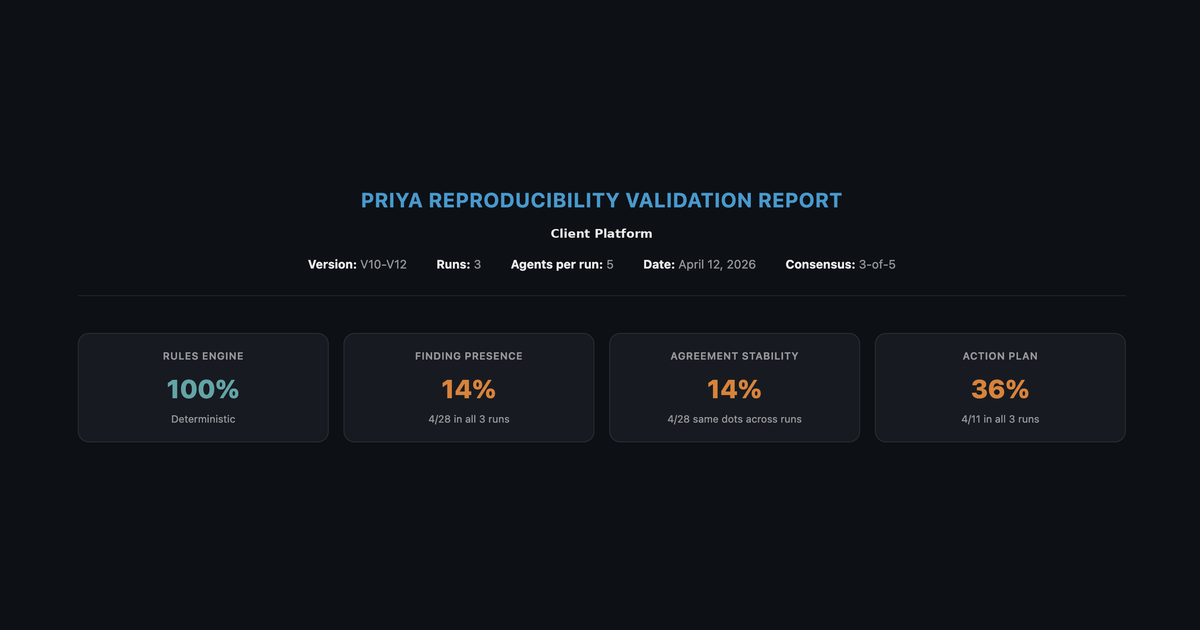
Reproducible. Run it on a portfolio company today. Run it again in six months after they've executed. Measure the delta. Show your LPs, with data, that commercial readiness has improved. That's not a subjective opinion. That's a measurement system. We validated this with a formal reproducibility study achieving 100% deterministic agreement across independent runs.
Benchmarkable. Because every assessment uses the same framework, you can compare commercial readiness across portfolio companies on an apples-to-apples basis.
We also built a strategic value-creation model that sits alongside the assessment, allowing investors to stress-test how probability of success, market penetration, pricing, and margin assumptions flow through to risk-adjusted value (rNPV), acquisition and licensing scenarios, and investor returns (MOIC and IRR). It connects the commercial assessment directly to the financial outcome.
Why This Matters for Your Portfolio
Every gap in a portfolio company's go-to-market program reduces its probability of commercial success. Every reduction in probability of success compresses returns. The math is unforgiving: a company with a 30% probability of success needs a much larger exit to deliver the same expected return as one with a 50% probability of success.
The question isn't whether commercial readiness matters. It's whether you're measuring it rigorously enough to act on it.
Our platforms give investors the tools to answer that question with evidence, not intuition. Whether you're evaluating a new deal, assessing a portfolio company's progress, or preparing a company for its next raise, MAYA, PRIYA, and GAIA deliver a structured, reproducible view of where the commercial program stands and exactly where to focus resources for maximum impact.
The Bottom Line
Life science investing rewards precision. The science matters. The regulatory pathway matters. But the commercial execution layer, the go-to-market program that turns a cleared product into revenue and revenue into returns, is where most value is created or destroyed.
If your due diligence doesn't include a rigorous, objective assessment of commercial readiness, you're making investment decisions with incomplete information. And in a space this complex, incomplete information is expensive.
We built the tools to close that gap. And we're ready to put them to work for your portfolio.
Want to see what PRIYA surfaces in your portfolio company's GTM program?
Back to Blog