THEIA: an agentic AI platform for the analysis of biotech investor decks
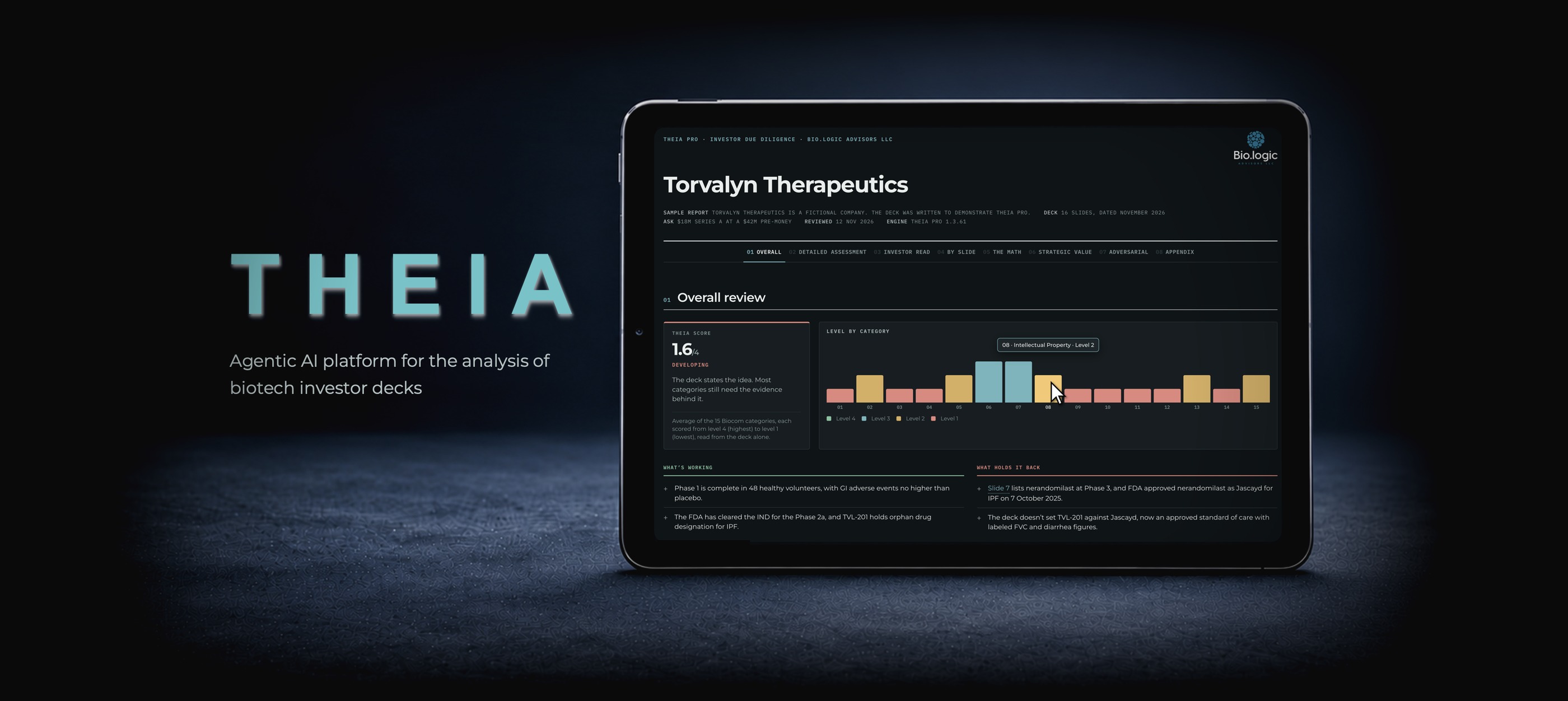
Developed in partnership with Biocom, THEIA PRO is an agentic AI investor deck analysis platform for biotechnology founder/CEOs and investors seeking to secure or invest capital.
Unlike alternative AI approaches that return inconsistent results or are too generic for the unique needs of biotech, THEIA PRO calibrates to your company type, scores your deck against a fixed rule set, validates claims against primary sources, and delivers the consistency and reproducibility needed to make more informed fundraising and investment decisions.
Who Is THEIA Pro For?
INVESTORS & BOARDS
Evaluating more opportunities, and allocating capital to the right ones calls for a deck review deep enough to act on and fast enough to keep deal flow moving.
CEOs & FOUNDERS
Securing funding starts with an airtight pitch deck that increases chances of success by completely and accurately addressing the topics investors most care about.
ACCELERATORS & INCUBATORS
Growing membership in incubators calls for providing measurable value for members that translates into secured funding by supporting coaching with an objective, consistent pitch deck evaluation platform.
CORPORATE DEVELOPMENT
Prioritizing which companies to fund or acquire calls for comprehensive, reliable analysis that complements the deep experience of corporate development teams.
The Pitch Readiness Platform for Life Science Founders
Founders receive plenty of advice on their pitch decks, but often lack an objective, evidence-based assessment of their investment narrative. They need to understand which claims withstand scrutiny, where critical gaps exist, and which improvements deserve priority. THEIA PRO delivers a structured, reproducible assessment against a consistent scoring framework, supported by external source validation and a prioritized action plan, within two business days of submission.
| Challenge | Founder implication |
|---|---|
| A failed first impression | First impressions carry significant weight in fundraising. Unsupported claims, inconsistent data, or unanswered questions undermine investor confidence and reduce the likelihood of advancing to the next meeting. |
| Difficulty identifying gaps | Founders know their science and business intimately, making it difficult to evaluate their own pitch decks objectively. Investors bring a fresh perspective, often identifying weaknesses in assumptions, evidence, and positioning that internal teams overlook. |
| Demand for defensible financials | Investors expect more than top-down market estimates and revenue projections. Founders need to substantiate obtainable market opportunity, pricing, market share, capital requirements, and potential investment returns with credible assumptions and supporting evidence. |
| Inconsistent, subjective feedback | Feedback from advisors, investors, and pitch competitions often varies by reviewer. Without a standardized evaluation framework, founders struggle to distinguish material weaknesses from personal preferences and prioritize improvements. |
The Diligence Platform for Life Science Investors
Investors need a consistent, evidence-based approach to evaluating early-stage life sciences opportunities. They need to distinguish substantiated claims from unsupported assumptions, identify material risks, and prioritize investments with confidence. THEIA PRO delivers a standardized, reproducible assessment supported by authoritative external sources, helping investors evaluate more opportunities while reducing the time and resources required for initial diligence.
| Challenge | Investor implication |
|---|---|
| Heightened investment scrutiny | Investors are more selective, placing greater scrutiny on every opportunity. Unsupported market assumptions, inconsistent financials, or unverified claims undermine credibility, regardless of the strength of the underlying science. |
| Resource-intensive diligence | Evaluating early-stage life sciences companies requires significant time and expertise. Validating patents, regulatory pathways, reimbursement, market assumptions, and comparable transactions adds complexity and cost to investment decisions. |
| Demand for verifiable evidence | Investment decisions require defensible findings supported by traceable evidence. THEIA PRO links scoring results to specific deck content and validates claims against authoritative external sources. |
| Financial return expectations | Valuation alone does not establish investment potential. Investors need to understand ownership, dilution, multiples on invested capital (MOIC), and internal rate of return (IRR) relative to the proposed investment. THEIA PRO quantifies these outcomes rather than relying on unsupported projections. |
What THEIA Pro Does to Every Pitch Deck
01 · Calibrates to your company typeTHEIA Pro scores your deck with an Agentic AI engine purpose built for your company type, so you can measure against the right benchmarks.
THEIA Pro was built from the ground up for life science companies. Therapeutics, tools, diagnostics kits, diagnostics labs, service labs and medical devices each carry their own rule set and their own benchmarks.
02 · Scores against industry benchmarksTHEIA Pro scores all 15 Biocom categories, so you can see where the deck stands against the industry standard investor deck rubric.
The detailed assessment gives each of the 15 categories a level from 1 to 4, and names the slide that level rests on.
03 · Fact checks claimsTHEIA Pro checks every claim, so you can walk in knowing which claims hold.
The slide-by-slide section checks patents, market sizes, comparable exits, cited publications, instrument specs, grant programs, regulatory status and first-in claims.
04 · Checks primary sourcesTHEIA Pro cites a source an investor can open, so you can stand behind every number.
Every claim goes to the official record: the patent office, the FDA, CMS. The investor read lists each benchmark beside the source it came from.
05 · Provides adversarial questionsTHEIA Pro asks the hard questions first, so you can answer them before an investor does.
The adversarial section writes the hardest questions an investor or an acquirer will ask, with talking points for each question.
06 · Pressure tests SAM / TAM / SOMTHEIA Pro rebuilds the math behind the raise, so you can defend the number you ask for.
The math rebuilds the obtainable market from units and price, level by level, with the formula and the price per unit at each level.
07 · Calculates rNPV for named buyerTHEIA Pro prices your company to a named buyer, so you can test the valuation you ask for.
Strategic value gives the risk-adjusted net present value (rNPV) the asset creates for a named buyer, then prices an acquisition, a license or OEM deal, and the fundraise, with multiple on invested capital (MOIC) and internal rate of return (IRR).
08 · Delivers reproducible resultsTHEIA Pro provides reproducible results, so you can engage in fundraising discussions with confidence.
Every major change to the engine goes through a reproducibility study. In the most recent study, three independent runs of each deck returned the same score and the same deal-stopping issues.
What Gets Checked on Every Deck
The platform goes through this list on every review.
Patents
THEIA Pro pulls the patent from USPTO, Google Patents or Justia, then reads the current assignee, the claim type, every claim in the patent, the continuations, and any co-assignment with a university.
Market sizes
Total addressable market, serviceable addressable market and obtainable market each carry a figure, and each figure cites its source.
Comparable exits
Each comparable deal carries its headline value, and the terms the deal was structured on.
Cited publications
THEIA Pro checks the indexing, the impact factor, the author conflicts, and the sample size the paper reports.
Instrument specs
Each stated spec is held against the vendor's published literature.
Grant programs
THEIA Pro reads each program's funding cap and any waiver, then checks whether a figure runs over the cap.
Regulatory status
THEIA Pro holds the status the deck claims against the status on record on the day of the review.
“First in” claims
THEIA Pro searches for anyone who reached the market or made the claim first.
Explore THEIA Pro
Click each button to explore THEIA Pro.
Overall Review
The deck is evaluated on a scale of 1-4 based on the 15 category rubric developed by Biocom as part of their PitchStudio program. What's working, what holds the deck back, as well as a prioritized list of suggestions provides a roadmap for what to improve.
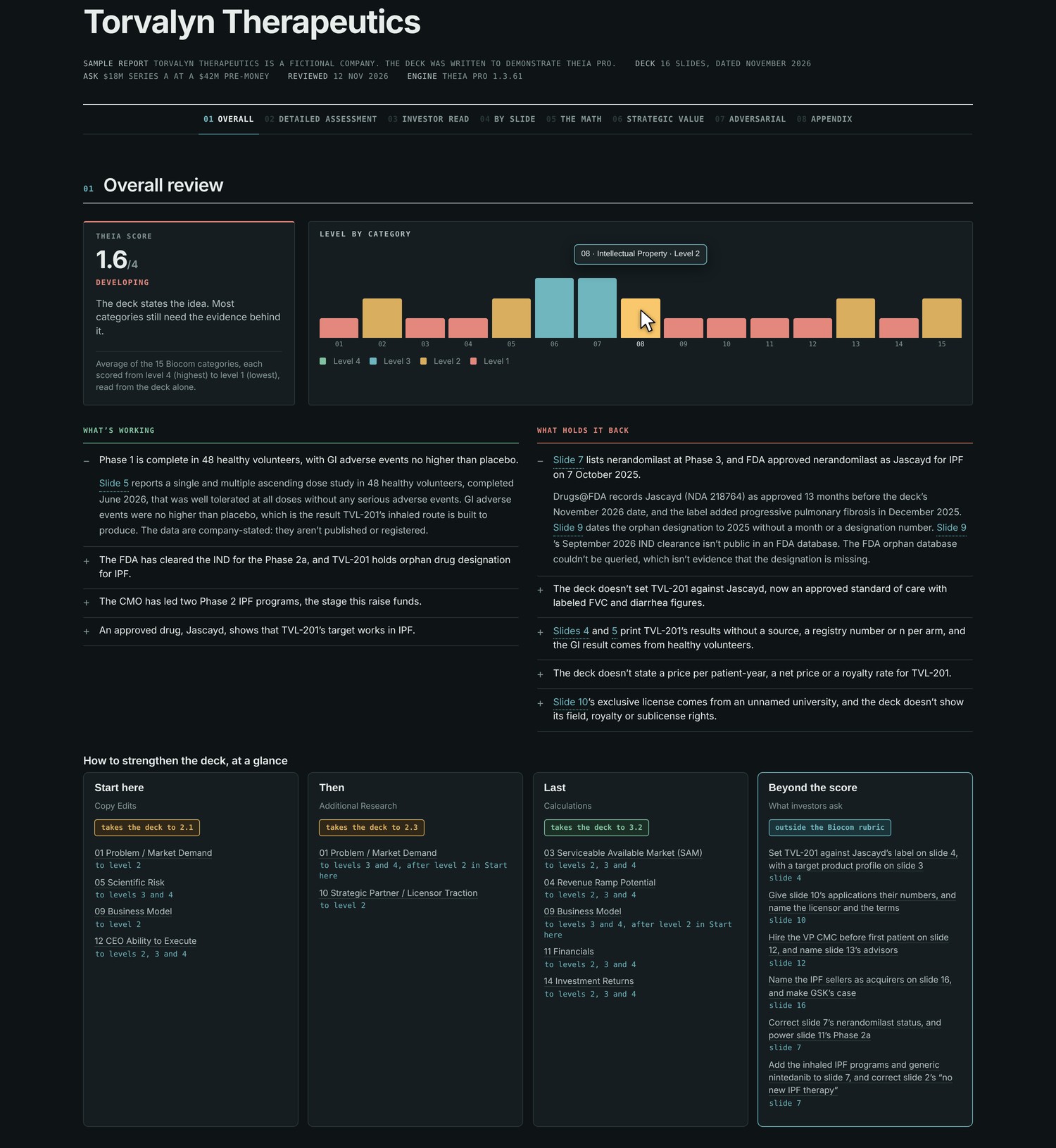
- Section nav Easily navigate the report. The section nav appears on every page.
- THEIA score The score averages the 15 Biocom category levels on a scale of 1 to 4.
- Level by category The chart plots all 15 Biocom categories at the level the deck scored.
- What's working Every claim the deck supports cites the slide the claim comes from.
- What holds it back Every gap cites the slide, and the source that contradicts the slide.
- How to strengthen the deck The fixes run copy edits, then added research, then rebuilt calculations.
Detailed Assessment
Every one of the 15 Biocom Pitch Studio categories gets a score from 1 to 4, along with clear guidance for what to do next to improve the score.
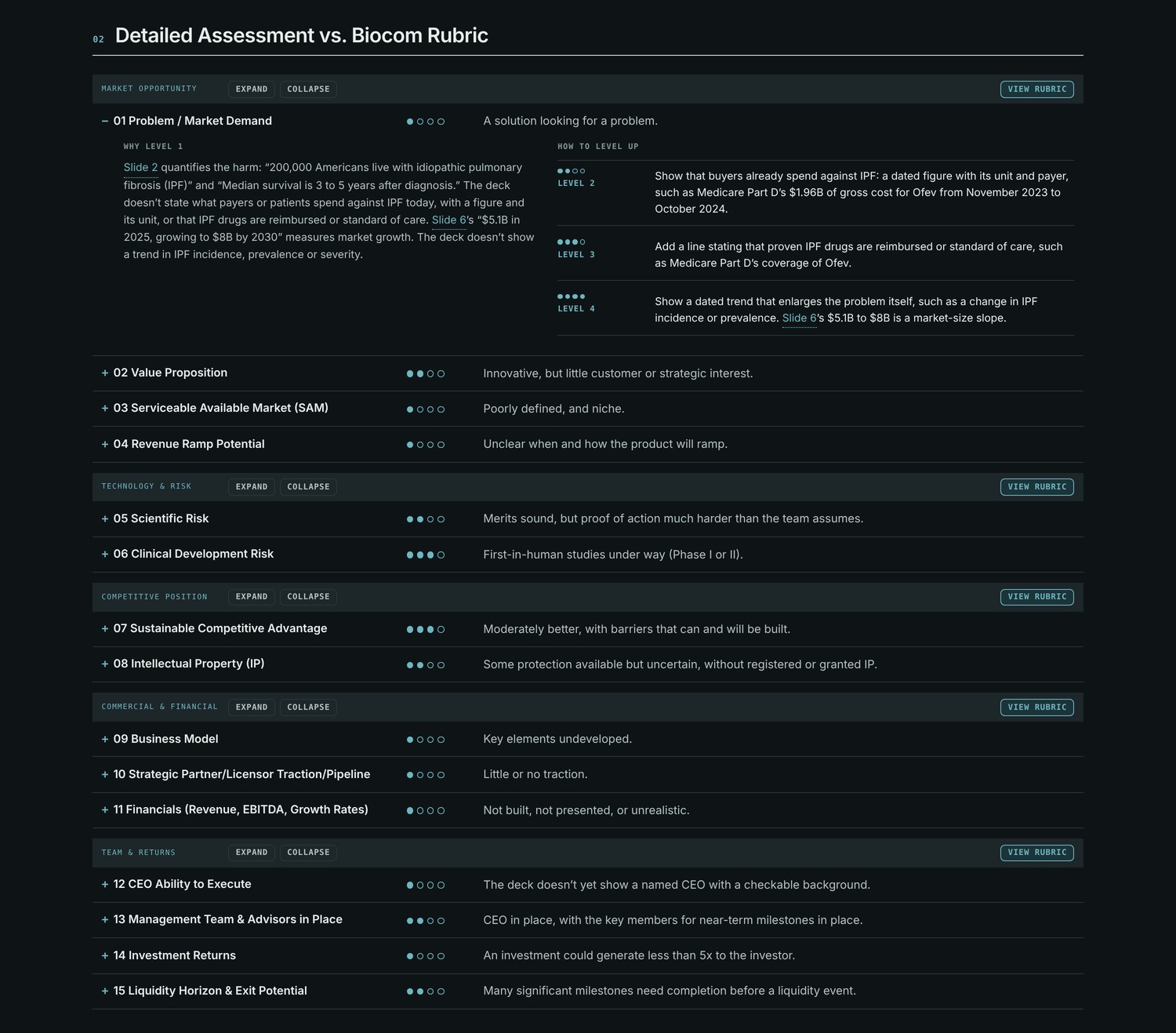
- Category group The 15 categories sit in five groups, and a group opens or closes as a block.
- View rubric The Biocom rubric for the group opens beside the scores.
- Category row The row carries the category, the level as four dots, and the label for that level.
- Why this level The reason quotes the deck, names the slide, and states what the slide leaves out.
- How to level up Each rung names the evidence the next level needs, and a source to cite for it.
Investor Read
THEIA Pro reads the deck the way an experienced biotech investor would: your thesis, your next value point, what the round buys, and what the round proves. THEIA Pro checks each premise against benchmarks and shows you where a figure could use more support.
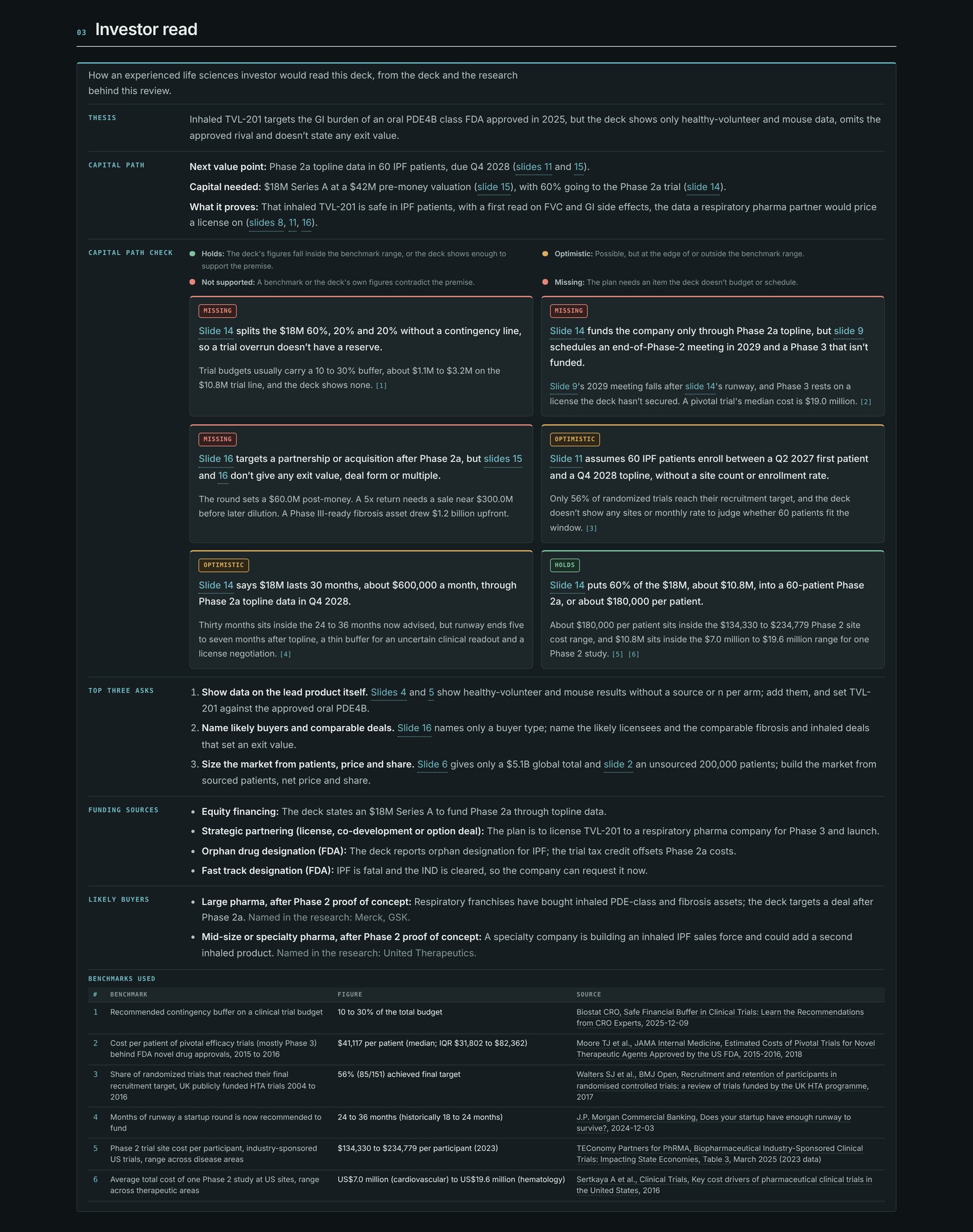
- The read THEIA Pro reads the deck the way an experienced biotech investor reads it.
- Thesis One line states what the company sells, to whom, and why the drug works.
- Capital path The capital path names the next value point, what the round buys, and what the round has to prove.
- Capital path check Every figure in the path is held against a dated source, and marked holds or fails.
- Top three asks The report ranks the three requests an investor makes before a term sheet.
- Benchmarks used Every benchmark carries its figure and the source the figure came from.
Slide by Slide
Each slide in your deck gets its own findings, a fact check, and the recommended fix. Where a figure doesn't match the source, THEIA Pro provides the source.
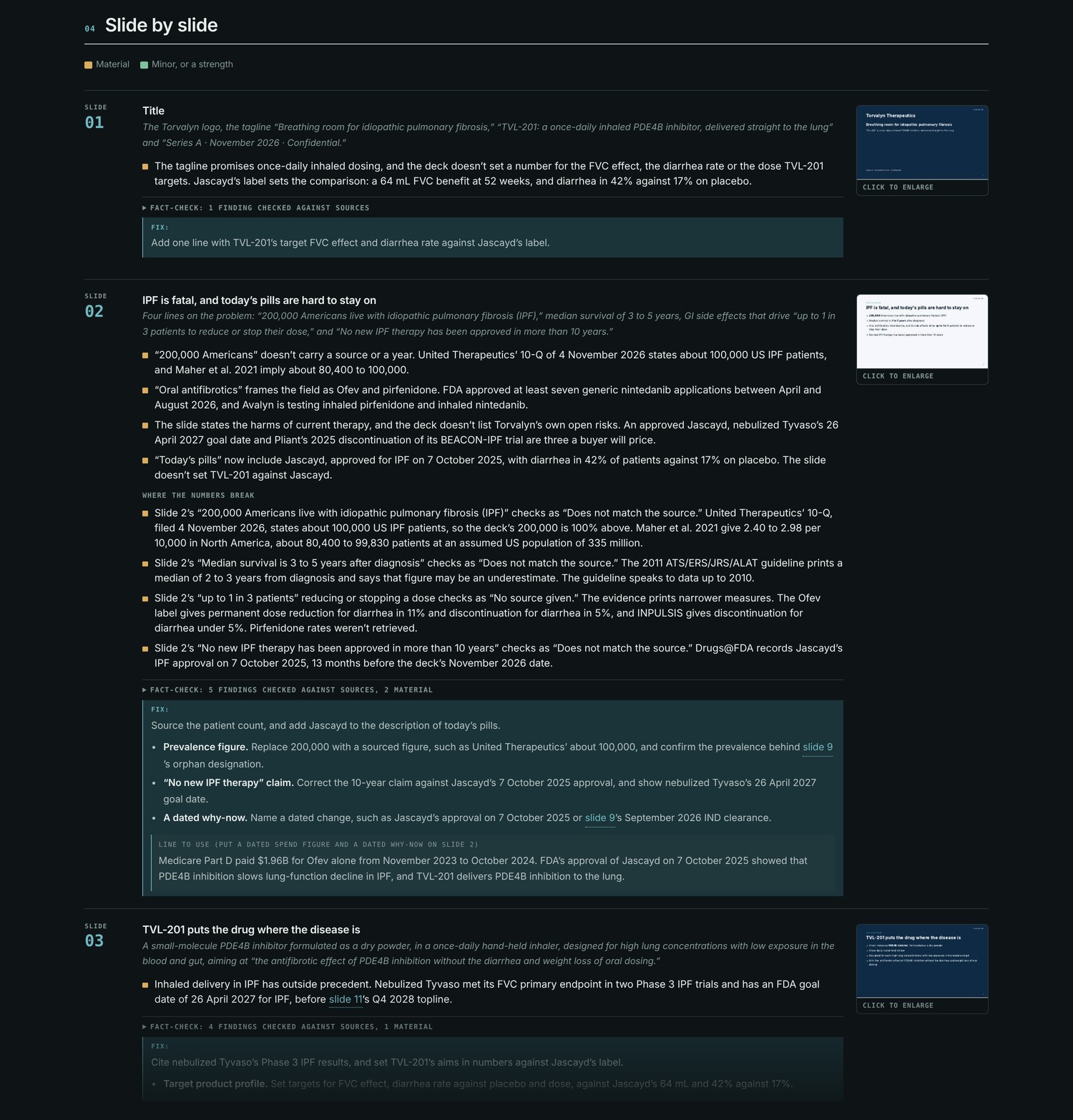
- Severity key A finding is marked material or minor, and a minor mark can be a strength.
- Slide number Every slide in the deck gets a numbered row, in deck order.
- Slide thumbnail The slide opens full size, so a finding can be checked against the slide itself.
- Observations Each observation names what the slide states, and what the slide leaves out.
- Fact check The fact check opens to show the claim, the source, and the result.
- Fix The fix gives the line to add, in the words the slide should carry.
The Math
THEIA Pro rebuilds the market in the unit you sell, from total addressable market down to year-5 revenue. Every level of the funnel shows the inputs behind that level, and the source for every input.
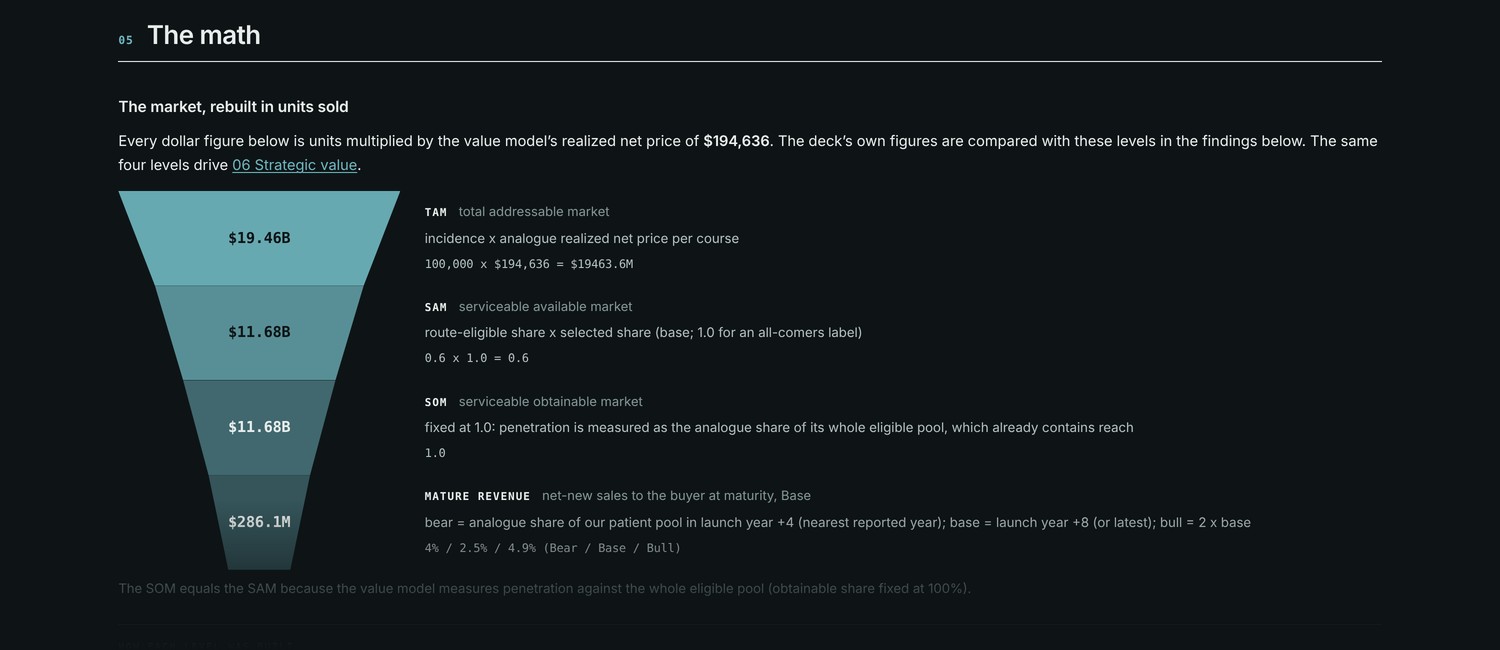
- Rebuilt market The market is rebuilt from units sold and price per unit.
- TAM The top of the funnel carries its own formula and the price per unit.
- SAM The route the company sells through cuts the market to what the company can reach.
- SOM Share and ramp cut the market again, to what the company can win.
Strategic Value
THEIA Pro values your company to a named buyer, risk-adjusted, and works out what your raise returns at that value using interactive controls.
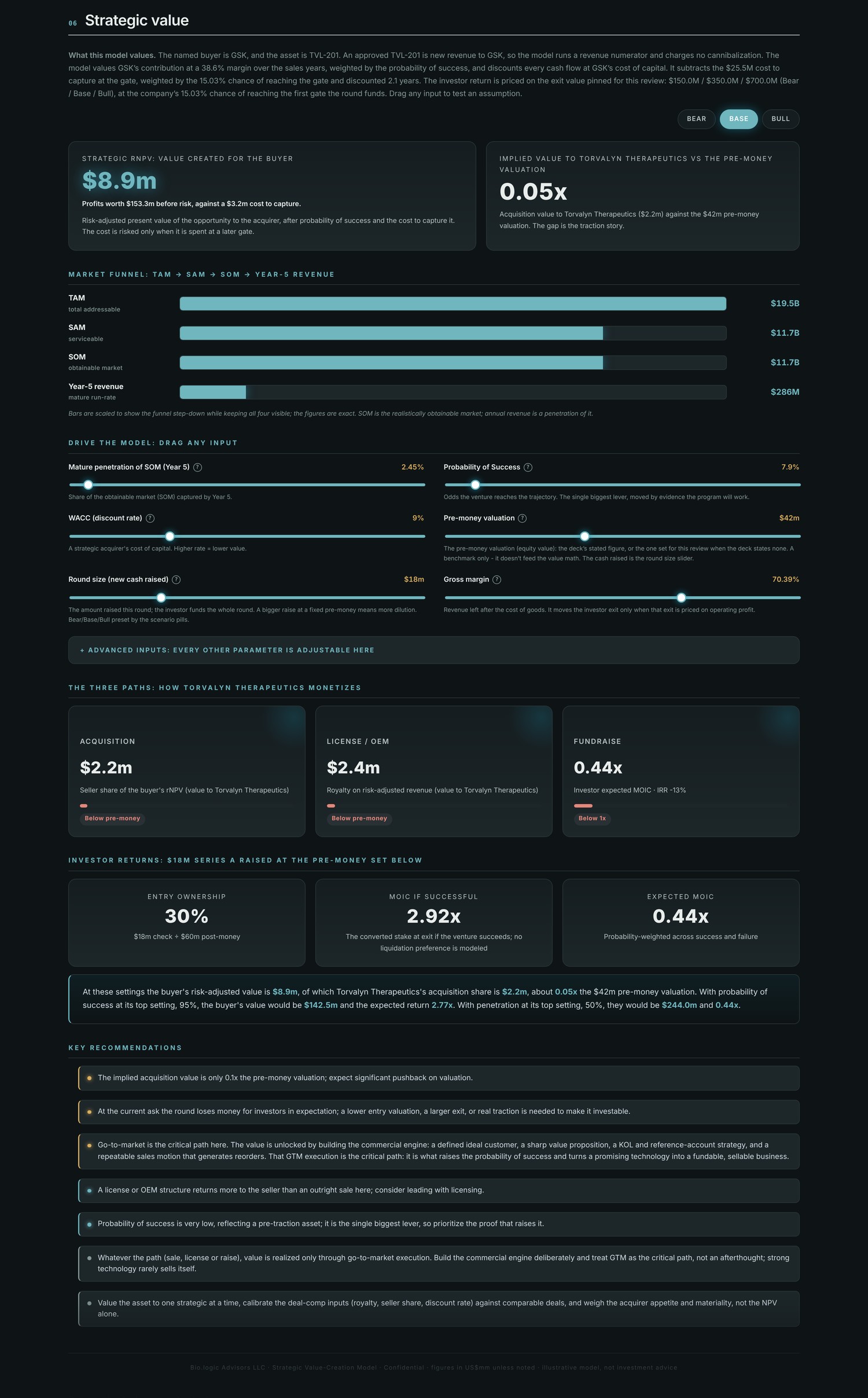
- Bear, base, bull Three scenarios, each with its own inputs, switch the whole model.
- Strategic rNPV The risk-adjusted net present value states what the asset creates for a named buyer.
- Implied value The implied value holds what the asset is worth to the seller against the valuation the deck asks for.
- Market funnel The funnel runs from total addressable market to year-5 revenue, and every level carries its own number.
- Drive the model Every input is a slider, so an assumption can be tested against the output.
- The three paths The same model prices three paths: an acquisition, a license or OEM deal, and a fundraise.
- Investor returns The returns block reports entry ownership, multiple on invested capital, and the probability-weighted return.
Adversarial
THEIA Pro writes out the hardest questions an investor or an acquirer might ask. For each question you get what a bad answer reveals, and what a good answer has to contain.
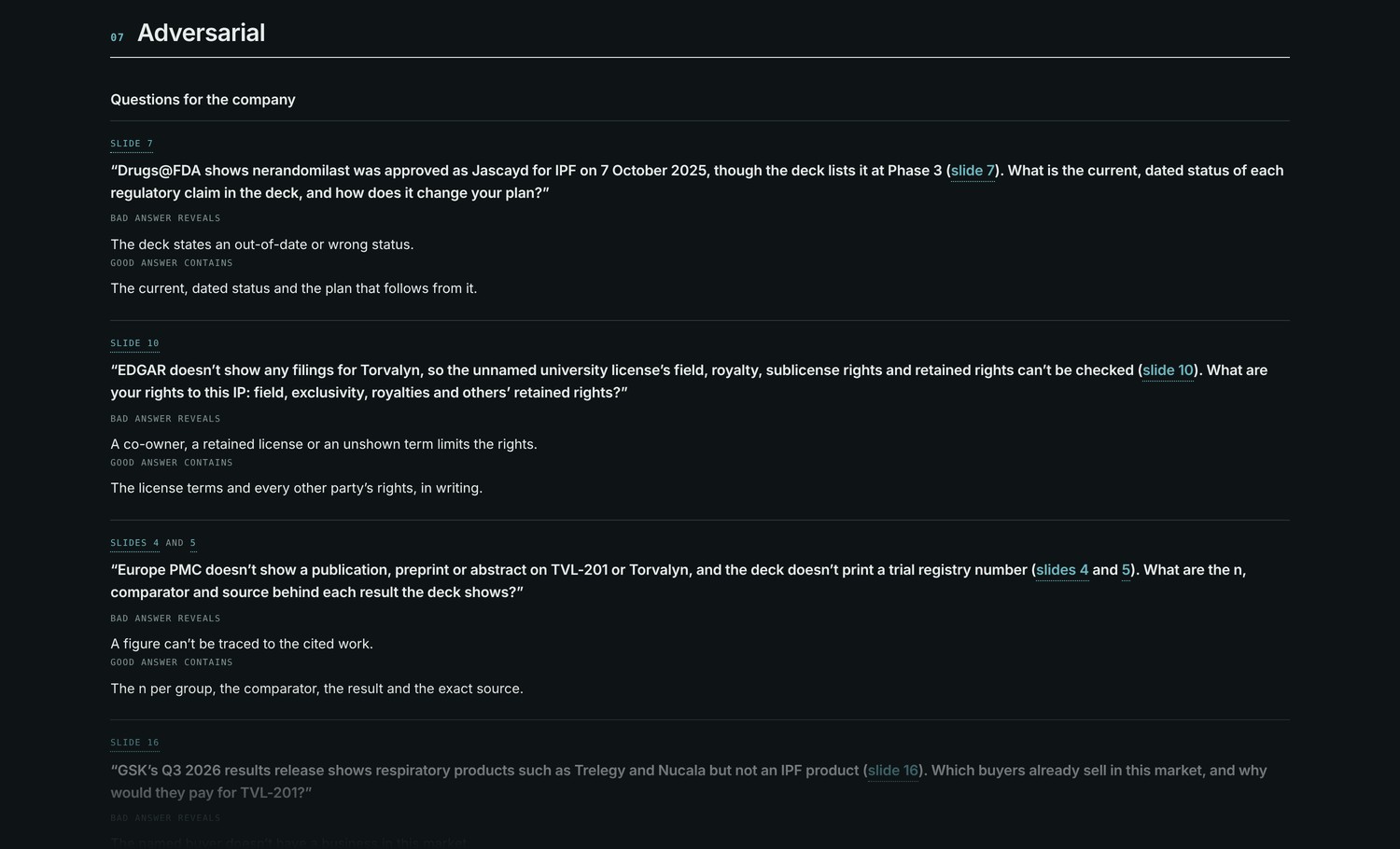
- Questions for the company The section writes the hardest questions an investor or an acquirer might ask.
- The question Each question cites the slide, and the source that raises the question.
- What a weak answer shows A weak answer tells the investor the problem is real.
- What a strong answer carries A strong answer names the current status, dated, and the plan that follows.
Consistency Is Key
We run a validation study for every major change to the engine. One such study covered three pitch decks, one for each of three archetypes: tools, diagnostics and therapeutics. Each deck got three independent runs, and each run started in a fresh session with new agents, so no run could see what an earlier run produced.
Reproducibility held at 100% across all runs.
Deck A came out at 1.9 in all three of its runs, Deck B at 1.4 in all three, and Deck C at 1.9 in all three. Every run of a deck gave exactly the same score, to the one decimal place the Biocom form uses. Two runs of each deck ran on Fable 5.1 and the third ran on Opus 5.5, so the score held across a change of model.
| Deck A | Deck B | Deck C | |||||||||
|---|---|---|---|---|---|---|---|---|---|---|---|
| Measure | Run 1 | Run 2 | Run 3 | Run 1 | Run 2 | Run 3 | Run 1 | Run 2 | Run 3 | ||
| AI model | Fable 5.1 | Fable 5.1 | Opus 5.5 | Fable 5.1 | Fable 5.1 | Opus 5.5 | Fable 5.1 | Fable 5.1 | Opus 5.5 | ||
| Score, on the 1 to 4 scale | 1.9 | 1.9 | 1.9 | 1.4 | 1.4 | 1.4 | 1.9 | 1.9 | 1.9 | ||
| Areas the same in all 3 runs | 15/15 | 15/15 | 15/15 | 15/15 | 15/15 | 15/15 | 15/15 | 15/15 | 15/15 | ||
Every run raised the same potential deal-stopping issues
| Problem | Run 1 | Run 2 | Run 3 |
|---|---|---|---|
| Deck A | |||
| The launch panel costs $649.16 in reagent against one billable unit at $324.58 | |||
| Slides 3 and 16 argue from a draft of coverage policy L40210, under wrong identifiers | |||
| The launch panel fails criterion 3 of coverage policy L40210 | |||
| The market, rebuilt at $9M to $108M a year, against the deck's $8.75B | |||
| Deck B | |||
| A slide titled “Series A financing” that doesn't give an amount, a pre-money valuation or a use of funds | |||
| Seven partnerships offered as the business model, without contract terms on any of the seven | |||
| Deck C | |||
| The $6M raise sits below the deck's own $7.1M loss for 2027 to 2029 | |||
| 29 slides without a price per unit or a unit count | |||
| Slide 14's 0.18% share measured against spending on finished tests | |||
Fundraising is tough. We'll get you ready in two easy steps.
Send Your Deck
Your THEIA Report Arrives
Pricing
Two business days from the day your deck arrives.
| Section | THEIA Core$3,500per deck | Biocom memberTHEIA CoreIncludedper deck | THEIA Pro$5,000per deck | Biocom memberTHEIA Pro$3,500per deck |
|---|---|---|---|---|
| Detailed AssessmentTHEIA scores all 15 Biocom categories at a level from 1 to 4. | ||||
| Slide citationsEvery level cites the slide the level came from, and names what the slide leaves out. | ||||
| Guidance for how to level upEvery category states what to add to reach the next level up. | ||||
| Overall ReviewTHEIA Pro puts every recommended fix in priority order. | ||||
| Investor ReadTHEIA Pro states the thesis and the capital path, then checks every figure in the capital path against a dated source. | ||||
| Fact checkEvery claim in the deck is checked against a primary source, and the report cites the source beside the claim. | ||||
| PatentsTHEIA Pro reads the current assignee, the claim type, every claim, the continuations and any university co-assignment. | ||||
| Market sizesEvery market figure cites the source the figure came from. | ||||
| Comparable exitsEach comparable deal carries its headline value and its terms. | ||||
| Cited publicationsTHEIA Pro checks the indexing, the impact factor, the author conflicts and the sample size. | ||||
| Instrument specsEach stated spec is held against the vendor's published literature. | ||||
| Grant programsTHEIA Pro holds each figure against the program's funding cap. | ||||
| Regulatory statusTHEIA Pro holds the status the deck claims against the status on record. | ||||
| “First in” claimsTHEIA Pro searches for anyone who reached the market or made the claim first. | ||||
| Slide by SlideEvery slide gets its own findings and its own fix. | ||||
| The MathTHEIA Pro rebuilds the market from units and price. | ||||
| Strategic ValueTHEIA Pro prices the asset to a named buyer, risk-adjusted, then reports multiple on invested capital (MOIC) and internal rate of return (IRR). | ||||
| AdversarialTHEIA Pro writes the questions an investor asks, and states what a weak answer shows and what a strong answer carries. |
Included Not included
Send your deck as a PDF or a PowerPoint file. We confirm scope and timing, then the review runs on the deck exactly as you sent it.
Frequently Asked Questions
Will THEIA Pro change my Biocom score?
No. THEIA Core and THEIA Pro score the 15 categories with the same scoring files, so the levels match. THEIA Pro adds the sections around the score.
Where do the facts come from?
Facts about your company come from your deck. Market figures, benchmarks and comparables come from published sources, and each one is cited in the report.
What do I receive?
An interactive report that opens in any browser with a password, a PDF of the report and reviewer notes. Each copy carries its own Copy ID.
How long does it take?
Two business days from the day your deck arrives.
What kind of company is THEIA Pro for?
Therapeutics, tools, diagnostics kit or lab, service lab and medical device companies. Each type has its own checks, benchmarks and definition of investor-ready, and THEIA Pro calibrates to the type before it scores.
What do you need from me to start?
Your deck, as a PDF or a PowerPoint file. We confirm scope and timing, then the review runs on the deck exactly as you sent it.
What's the difference between THEIA Core and THEIA Pro?
THEIA Core scores the 15 Biocom categories without outside research, and returns a short report. THEIA Pro adds the fact-check against primary sources, the investor read, slide-by-slide fixes, the rebuilt market math, the strategic value model and the adversarial questions.
Will I get the same answer if you run it again?
Yes. The same deck returns the same score and the same deal-stopping problems. The Consistency Is Key section shows a validation study where the score held across all nine runs.
What if THEIA Pro gets something wrong?
Send us the source. Every finding carries the slide or the source it rests on, so a correction is quick to make and we reissue the report.
Does THEIA Pro rewrite my deck?
No. THEIA Pro tells you what to fix, in order, on your own slides.
Is my deck kept confidential?
Yes. Your deck is kept confidential. Each THEIA Pro run is issued with its own unique identifier, and the report is password protected.